
The short answer
There is no single “best” kitten food, but the closest thing to the right answer is a commercially prepared food formulated for growth. Look for a label that states the food is “complete and balanced” according to AAFCO nutrient profiles for growth, or “all life stages.” That statement is the most reliable quality signal you can check on a store shelf. Feed that formula — wet, dry, or a mix — from weaning until about 12 months of age, and adjust portions to your kitten's body condition rather than a fixed chart.
Why kittens cannot just eat adult cat food
A kitten's first year is the fastest growth phase of its life. In just a few months, a kitten grows from a palm-sized newborn into a nearly full-sized cat, building muscle, bones, teeth, eyes, and brain tissue at a remarkable rate. Adult “maintenance” food is formulated for a body that has stopped growing, so it contains less protein, fat, calcium, phosphorus, and certain vitamins than a growing kitten needs. Feeding it as the main diet during kittenhood can contribute to slow growth, poor bone development, and a dull coat.
Kitten food is also more energy-dense, which matters because a kitten's stomach is tiny. A few tablespoons cannot carry enough calories if the food is too dilute, so kitten formulas pack more usable energy into each bite. For the same reason, many kittens do best with small, frequent meals rather than one or two big bowls.
The nutrients below do the heavy lifting during kittenhood:
| Nutrient | Why kittens need it | What to check |
|---|---|---|
| Protein | Building blocks for muscles, organs, and immune defenses | Higher protein than adult maintenance food |
| Fat | Concentrated energy and healthy skin and coat | More calories per cup than adult food |
| Calcium and phosphorus | Bone and tooth formation | Balanced ratio in a growth formula |
| DHA | Supports brain and eye development | Omega-3 often added in kitten recipes |
| Taurine | Heart and vision health | Present in every complete cat food |
Calcium and phosphorus deserve special attention. The ratio matters as much as the amount — which is one reason homemade or raw recipes are risky for kittens without veterinary guidance. A well-formulated commercial kitten food gets the balance right. Taurine is also essential because cats cannot make it themselves; every complete cat food, including kitten food, contains it.
How to find a truly complete kitten food
Five practical checks:
-
Find the nutritional adequacy statement. On U.S. foods this is a line from AAFCO saying the food is complete and balanced for “growth,” “growth and reproduction,” or “all life stages.” If it only mentions adult maintenance, put it back.
-
Look for a named protein source near the top of the ingredients list, such as “chicken,” “salmon,” or “turkey.” Ingredients are listed by weight, so a named meat first is a decent sign.
-
Prefer foods tested in feeding trials. Labels may say a food “is formulated to meet” AAFCO profiles or that it “passed feeding trials.” The latter is a stronger guarantee.
-
Ignore the marketing words. “Natural,” “premium,” “holistic,” and “gourmet” are not regulated terms with a precise meaning. The AAFCO statement matters far more.
-
Choose a company with veterinarians on staff and transparent quality control. You do not need the most expensive bag on the shelf — you need the most reliably complete one that your kitten will actually eat. Budget-friendly store brands can still meet AAFCO profiles, so price alone is not a quality signal.
Wet food, dry food, or both?
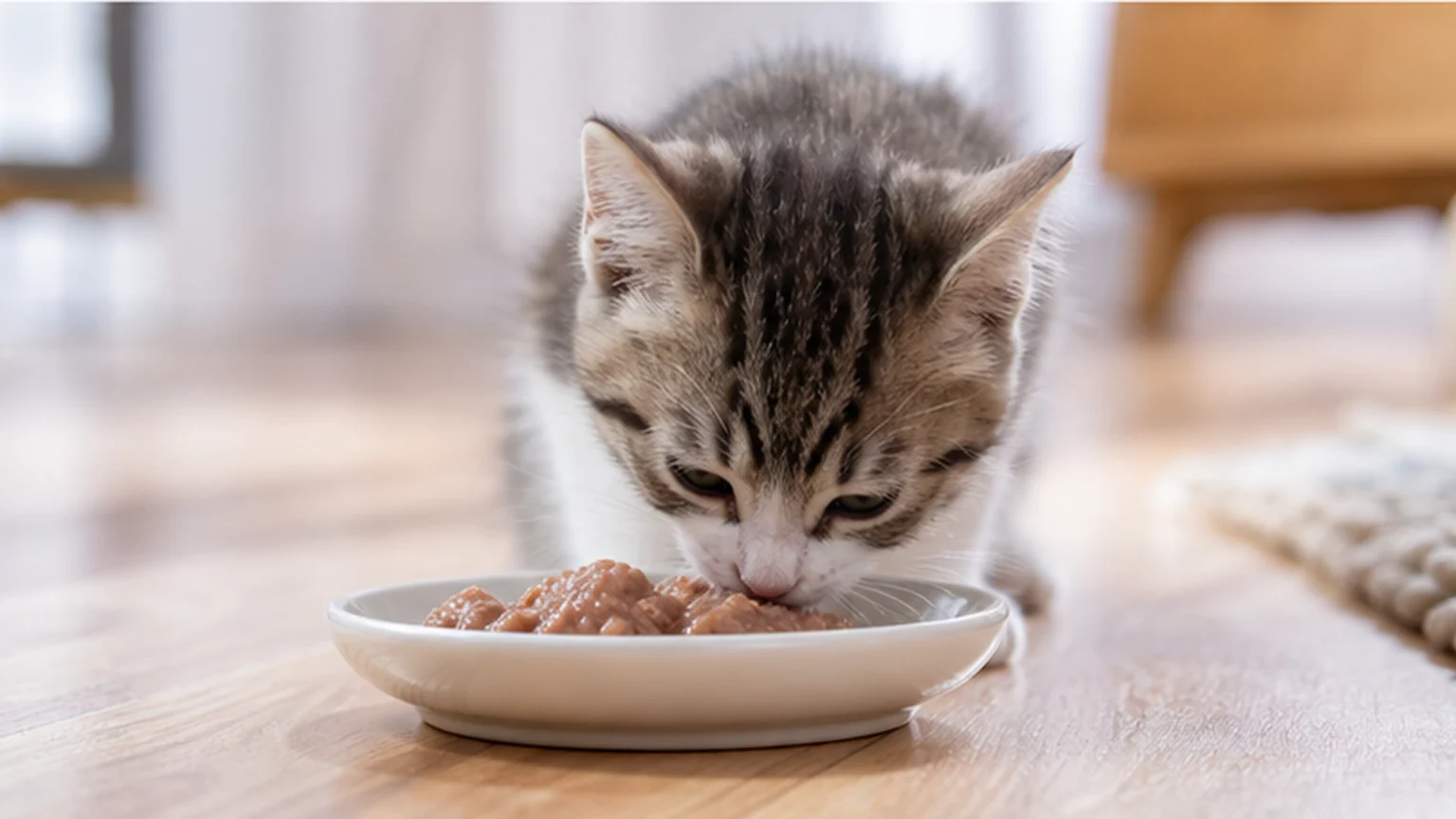
Both formats can be excellent for kittens, and many owners feed a mix. Wet food has high moisture content, which helps kittens stay hydrated — cats have a naturally low thirst drive. It is also soft and easy for young kittens with developing teeth. Dry food is convenient, does not spoil quickly, and is very energy-dense, which is useful for tiny stomachs. The trade-off is that dry food contains very little water.
A practical compromise is a morning and evening meal of wet kitten food plus a measured portion of dry food available for grazing. If you feed dry food free-choice, keep track of how much disappears so you can adjust portions — “free-choice” does not mean “bottomless.” Whatever you choose, make sure every product carries the AAFCO growth statement.
Kittens have small stomachs, high energy needs, and little reserve if they stop eating. Never leave wet food sitting out for more than a few hours, because it spoils and can cause stomach upset. If a kitten under six months goes more than 24 hours without eating, call your veterinarian right away. And skip the saucer of cow's milk: most kittens are lactose-intolerant after weaning, and it can cause diarrhea. Fresh water is all a kitten needs to drink.
Homemade and raw diets: a special word of caution
Homemade kitten food sounds appealing, but it is very hard to get right. Kittens need precise levels and ratios of calcium, phosphorus, vitamin A, taurine, and other nutrients, and an unbalanced recipe can cause serious bone and organ problems. Store-bought raw diets also carry risks of bacterial contamination for both kittens and the humans handling them. If you are determined to go this route, do it only with a veterinary nutritionist's guidance — not a recipe you found online. For nearly every household, a well-known commercial growth formula is the safer and simpler choice.
How much and how often to feed your kitten
From weaning (around four weeks) to about six months, plan for three to four small meals a day. At six to twelve months, two to three meals a day is enough. Kittens are growing so quickly that their calorie needs change week to week, so the portion chart on the bag is only a starting point.
Use a kitchen scale to weigh portions — a cup measurement varies with kibble size and density. Then look at your kitten, not just the chart. You should be able to feel the ribs easily but not see them, and there should be a visible waist when you look from above. If the kitten is getting pudgy, cut portions slightly. If ribs are very prominent, increase them. Your vet can track weight gain at checkups and tell you whether your kitten is on a healthy curve.
Growth is not perfectly straight — kittens go through puffy and lanky phases — so judge health over weeks, not over a single day. Always keep fresh water available, and wash food bowls daily to prevent bacterial buildup.
When to switch to adult food
Most kittens can move to adult food around 10 to 12 months of age. Large breeds such as the Maine Coon sometimes continue on growth food until 18 months because they take longer to finish growing; your vet can advise you. Spaying or neutering changes energy needs, and the switch to adult food is a good moment to revisit portion sizes.
Transition gradually over 7 to 10 days by mixing: start with about 25 percent new food, then 50, then 75, and finally all adult food. A sudden change can cause stomach upset. Kittens are creatures of habit, so keeping the same brand family for the adult food can make the switch easier, though it is not required.
Frequently Asked Questions
Can kittens eat adult cat food?
Not as a staple. An occasional nibble will not hurt, but adult food lacks the protein, fat, calcium, and vitamins kittens need. Feed growth formula until about 12 months.
Is wet or dry food better for kittens?
Both can be excellent. Wet food contributes water; dry food is convenient and energy-dense. Many kittens thrive on a mix of the two.
Do kittens need grain-free food?
No. Grains are not harmful to most kittens, and grain-free is not more nutritious. What matters is the AAFCO growth statement.
How do I know if my kitten is eating the right amount?
Monitor body condition: ribs easily felt but not seen, a visible waist, and steady weight gain. Adjust portions every week or two based on what you see.
Should I give my kitten milk?
No. After weaning, most kittens lose the ability to digest lactose, and milk often causes diarrhea. Water is all they need.
Key Takeaway
The best food for your kitten is a complete-and-balanced growth formula from a reputable brand — wet, dry, or mixed — fed in the right amount and adjusted to your kitten's body condition. Start with a growth formula at weaning, feed several small meals a day, and transition to adult food around 12 months. When in doubt, your veterinarian is the best guide for your individual kitten.
Sources & Scientific References (3)
Share this guide
Help another cat parent find it.