Use this as a starting estimate
A calorie result is an estimated starting range, not a prescription. Adjustments may be needed for body condition, age and life stage, neuter status, activity, medical conditions, food calorie density, and weight trend over time.
The short answer
Feed from an estimated calorie range, convert it using the food label, and adjust with body condition and weight trends. There is no universal number of cans, cups, or pouches for every cat.
The calculator provides a starting range, not a prescription.
What determines how much a cat needs?
Two cats of the same weight can need different amounts. A useful starting estimate considers several factors together:
| Factor | Why it matters |
|---|---|
| Life stage | Kittens, adults, seniors, and pregnant or nursing cats have different nutritional demands. |
| Body condition | Current weight does not show whether a cat is underweight, in an appropriate condition, or carrying excess body fat. |
| Activity and environment | A highly active cat may use energy differently from a sedentary cat, but labels such as “indoor” do not produce an exact number. |
| Neuter status | Spaying or neutering can be relevant to an energy estimate. |
| Health and weight goal | Illness, unexpected weight change, and planned gain or loss require individualized advice. |
| Food calorie density | Equal-looking portions of different foods can contain very different calories. |
This is why a recommendation based only on “one cup,” “one can,” or the cat's weight is incomplete.
A simple feeding workflow
- Estimate daily calories.
- Check the food's calorie density.
- Convert calories into wet-food portions, dry-food portions, or a mix.
- Include treats and measure consistently.
- Recheck body condition and weight trend rather than changing portions based on one day's appetite.
1. Choose an appropriate food
Look for a nutritional adequacy statement showing that the main food is complete and balanced for your cat's life stage. Foods labeled for supplemental or intermittent feeding should not silently become the whole diet.
Format is a separate decision. Wet food provides more moisture, while dry food is convenient to measure and use in puzzle feeders. A mixed routine can use both. None of these choices removes the need to check calories and portions.
2. Estimate a daily calorie range
Use the cat calorie calculator to organize a starting estimate. Enter current information as accurately as practical and treat the result as a range to evaluate. A mathematical output cannot account for every individual difference.
3. Convert calories using the exact label
Find calories per can, pouch, tray, cup, kilogram, or gram. Check the exact recipe and package size; do not transfer a portion from a previous product merely because the containers look similar.
4. Create one daily allowance
Add the planned calories from every food source. Wet meals, kibble, treats, toppers, dental products, and food used for medication all belong in the same daily picture. Decide who feeds what so multiple household members do not unknowingly duplicate meals.
5. Monitor and reassess
Measure consistently, observe appetite, and track body weight and condition over time. The feeding plan is a starting hypothesis: monitoring shows whether it remains reasonable.
How to convert the result
For wet food, divide daily calories by calories per can, pouch, tray, or gram. For dry food, divide by calories per cup or gram; weighing dry food can improve consistency. In both cases, include treats, toppers, supplements with calories, and food offered by other household members.
For example, 200–250 estimated calories divided by a 100-calorie can works out to 2–2.5 cans as a mathematical demonstration. It is not a recommendation for every cat.
Kittens, adults, seniors, indoor cats, neutered cats, and highly active cats may have different needs. Health conditions can change the plan further.
Wet, dry, and mixed feeding
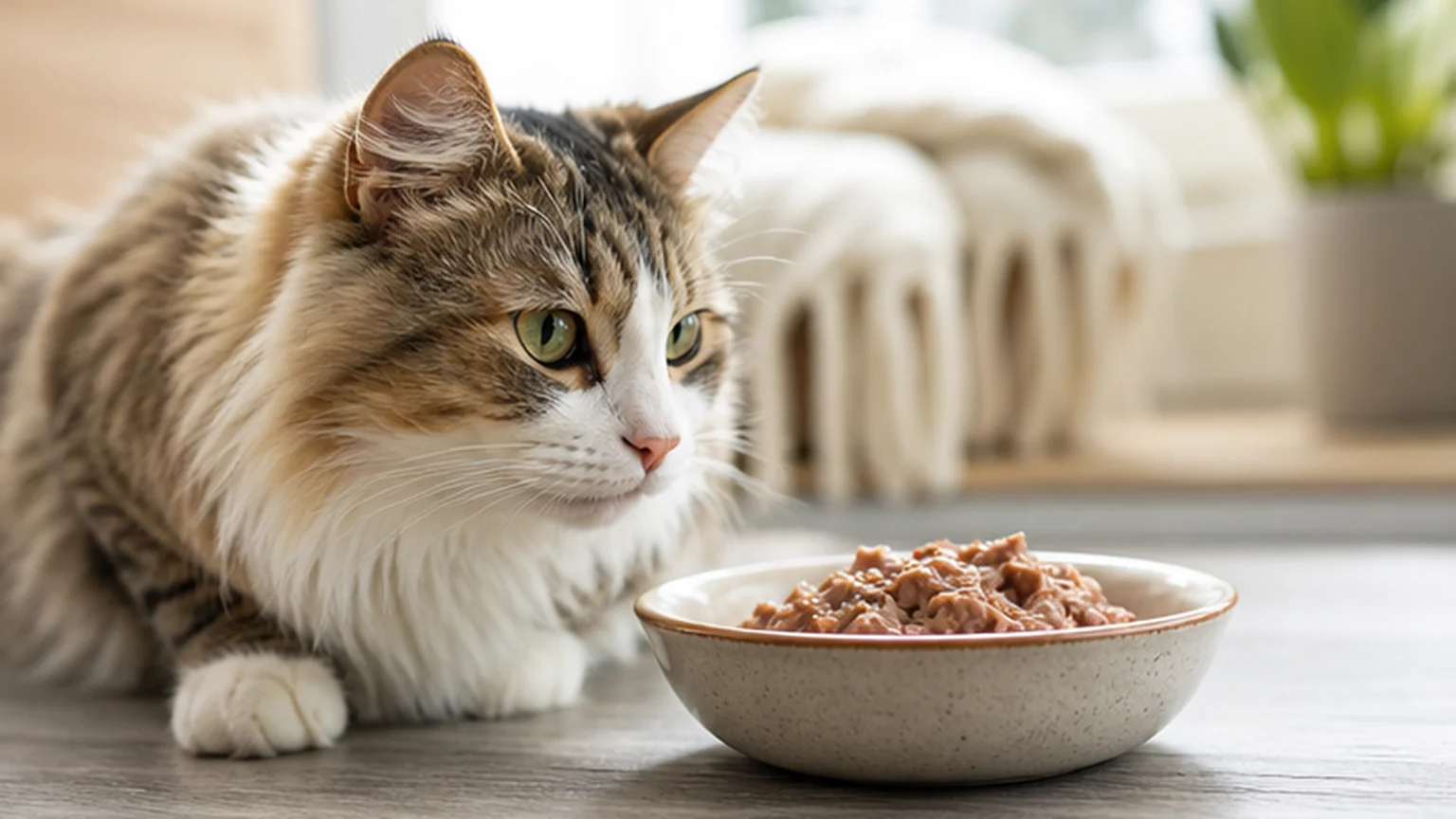
For wet food, check calories per container or gram. Partial cans and pouches can be weighed for consistency, then covered and refrigerated according to the label. Divide the daily amount into meals your cat will eat before the food has sat out too long.
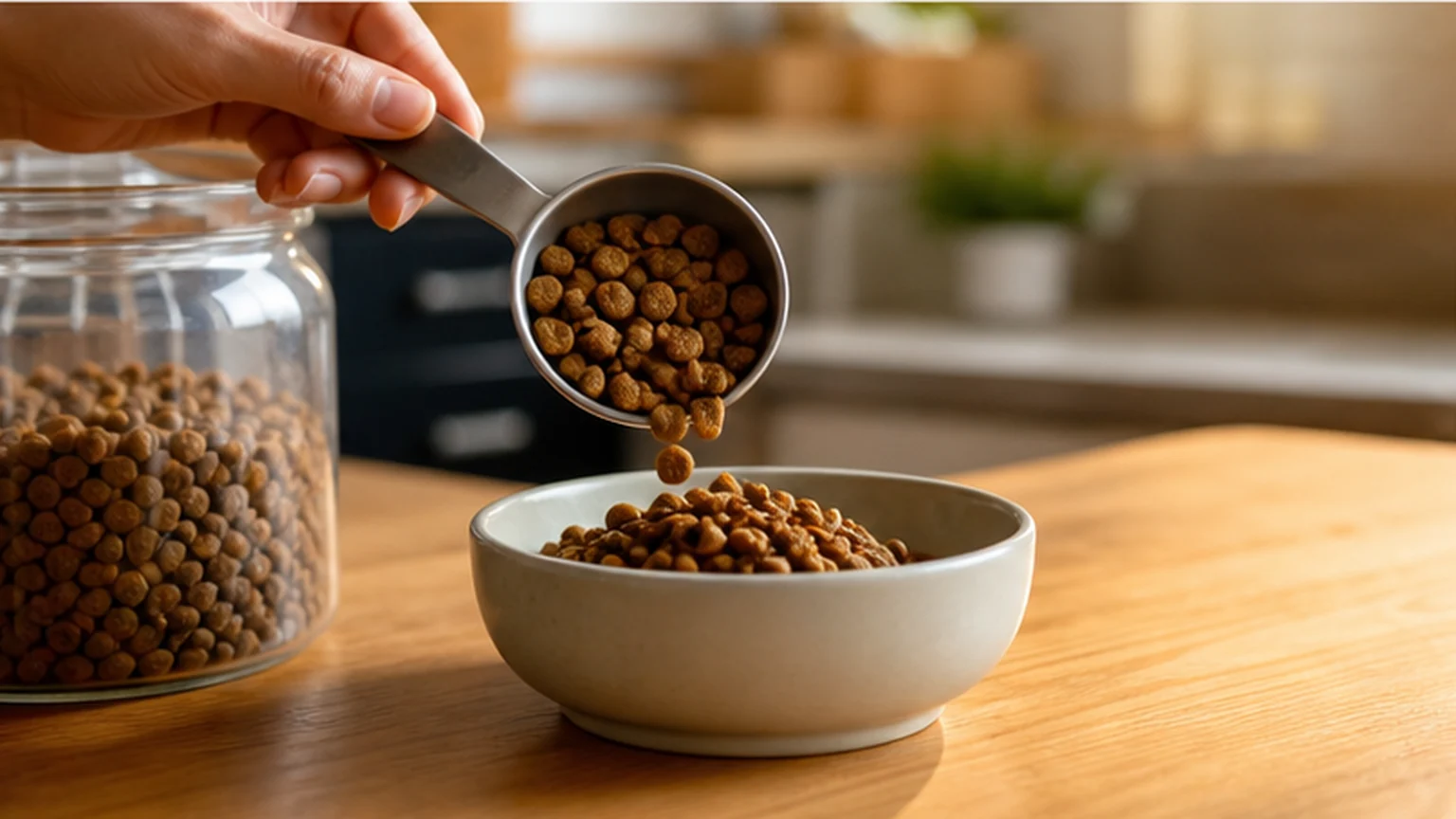
For dry food, grams are often easier to reproduce than a household cup. Kibble is commonly energy-dense, so a small heaped scoop can add meaningful calories. A pre-weighed daily container can supply meals, training rewards, and puzzle feeders without losing track of the total.
For mixed feeding, allocate calories before serving. If part of the estimate is assigned to wet food and treats, only the remainder is available for dry food. Feeding the full suggested wet amount and the full suggested dry amount is not a balanced mixture; it is two overlapping allowances.
How often should a cat eat?
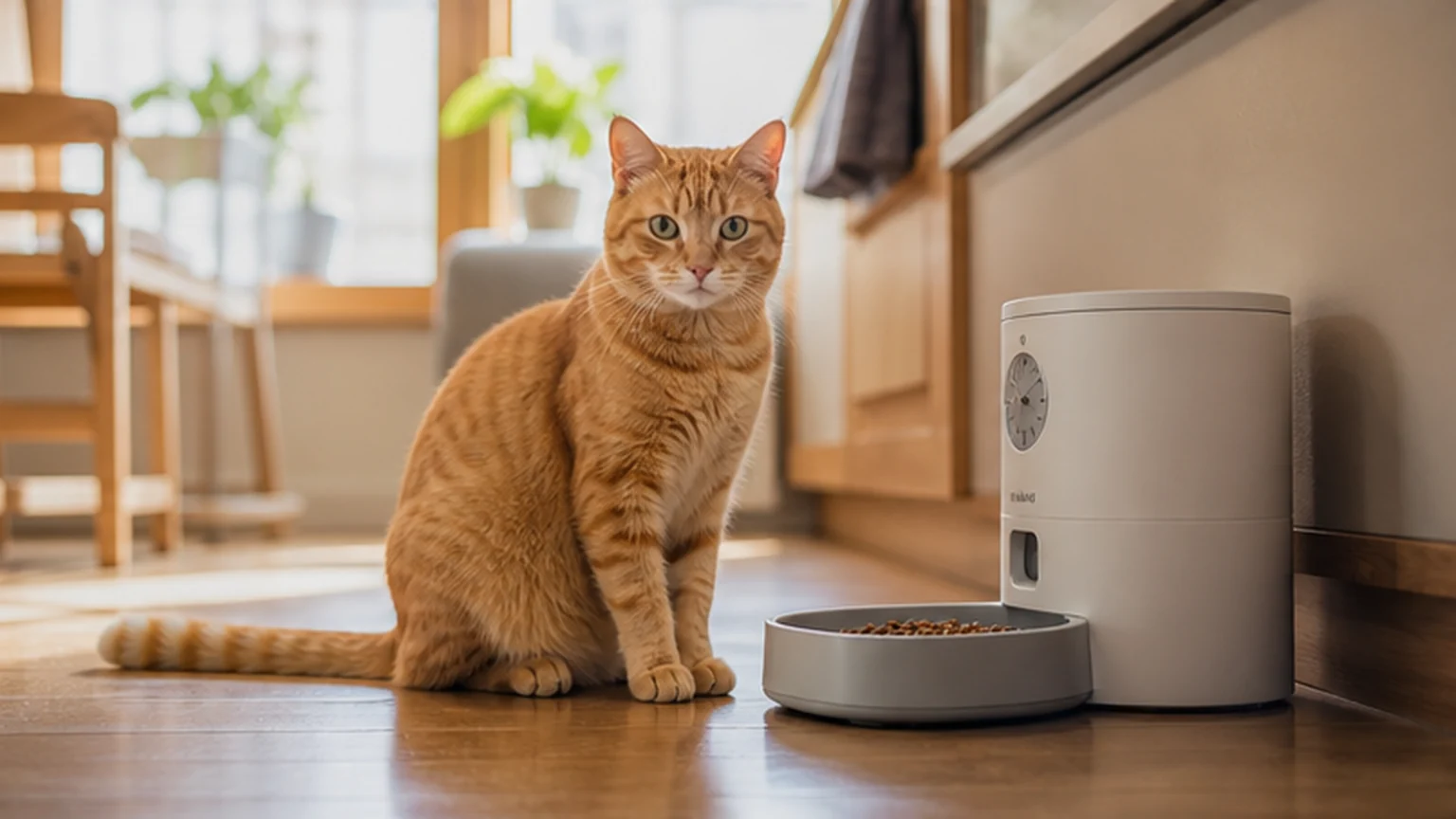
Meal frequency is partly practical and individual. Many cats prefer several small meals, but two or three measured meals may fit a household better. Timed feeders can divide portions across the day, and puzzle feeders can add activity for cats who eat kibble.
The schedule should make actual intake visible. If a cat grazes, offer a weighed daily allowance rather than repeatedly topping up an unmeasured bowl. In multi-cat homes, separate rooms, supervised meals, or microchip feeders can show whether each cat receives the intended portion.
Predictability helps you notice a change. A cat that normally finishes breakfast but suddenly walks away provides clearer information than a shared bowl that is always available.
Treats and extras
Treats should be counted, not treated as calorie-free because each piece is small. The same applies to lickable snacks, table food, toppers, supplements containing calories, and kibble used for play or training.
One simple method is to measure the day's dry allowance in the morning and take all kibble rewards from that container. If treats are separate products, reserve their calories before calculating the main meals. Avoid allowing extras to displace so much complete food that the overall diet becomes unbalanced.
Measure in a repeatable way
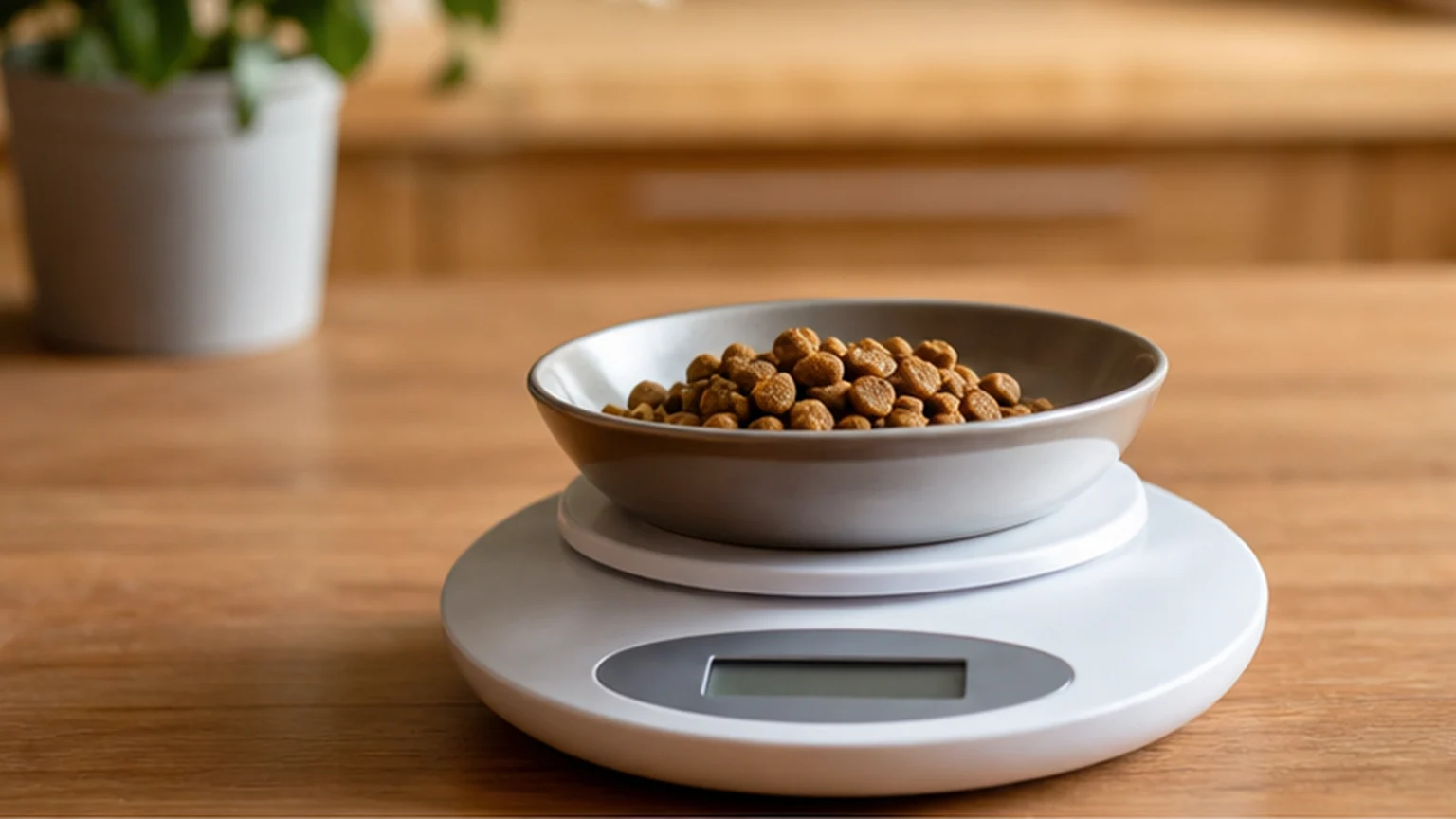
A kitchen scale can make dry food and partial wet-food packages easier to measure. Place the empty bowl on the scale, set it to zero, and add the intended grams. If you use a cup, use a defined level measure rather than a variable scoop.
Keep a short feeding record during changes. Note the food, amount offered, leftovers, treats, and who fed the cat. This often reveals simple explanations—such as an unnoticed second breakfast—before the main portion is adjusted.
Assess body condition and weight trend
Body weight is useful but incomplete. Body condition considers features such as the ribs, waist, and abdominal profile. Your veterinary team can show you how to assess these features and set an appropriate goal.
Use the same scale and similar timing when practical. Do not chase every small fluctuation. Look for a sustained trend and consider whether the food, label, measuring method, or activity changed. Muscle condition also matters, particularly in older cats, so a stable number does not answer every nutritional question.
Signs the amount may need review
An unexpected weight trend, persistent increased or decreased appetite, regular uneaten meals, or a noticeable change in body condition is a reason to review the plan. Measure consistently before drawing conclusions, and involve a veterinarian when the change persists or is substantial. If your cat seems hungry all the time, our guide to why cats are always hungry covers the common causes.
Do not make aggressive calorie reductions or attempt a therapeutic diet without veterinary guidance. Seek prompt advice if a cat stops eating or eats much less than usual, especially with vomiting, weakness, pain, breathing changes, or other illness signs.
Common feeding mistakes
- Following the package chart indefinitely without monitoring the cat.
- Assuming every can, pouch, or cup contains similar calories.
- Adding a second food without subtracting it from the daily total.
- Forgetting food offered by children, visitors, or another caregiver.
- Using a heaped scoop whose amount changes each day.
- Letting multiple cats share food when their portions differ.
- Making a sharp restriction after one high scale reading.
- Changing several foods and meal variables at once, making the result difficult to interpret.
Calculator output is an estimated starting range, not a prescription. Ask a veterinarian for individualized advice if your cat is growing, pregnant, losing or gaining weight unexpectedly, or has a medical condition.
Frequently asked questions
Should I feed the amount printed on the package?
Use it as broad starting information. Check the calorie statement, compare it with an individualized estimate, and monitor body condition and weight trend.
Is wet food or dry food easier to portion?
Either can be measured accurately. Dry food is convenient to weigh in grams; wet food can be divided by container or gram. The exact label matters more than format.
What if my cat begs between meals?
Begging does not by itself prove the portion is too small. Confirm the calculation, feeding schedule, enrichment, and whether other cats are involved. Persistent appetite change or weight change should be discussed with a veterinarian.
When should I change the amount?
Review it after a food change, life-stage transition, sustained weight trend, meaningful activity change, or veterinary recommendation. Make substantial weight-loss or medical adjustments with professional guidance.
Key takeaway
There is no universal serving size for cats. Start with an estimated calorie range, convert it using the exact food label, count every food source, and measure consistently. Then use appetite, body condition, weight trend, life stage, and veterinary guidance to decide whether that starting plan still fits.
More from this cluster
Continue with daily calorie requirements, wet-food portions, and dry-food portions.
Estimate your cat's daily calorie range
Use PurrWise's calculator for a practical starting estimate, then compare it with body condition and weight trend.
Sources & Scientific References (3)
Share this guide
Help another cat parent find it.