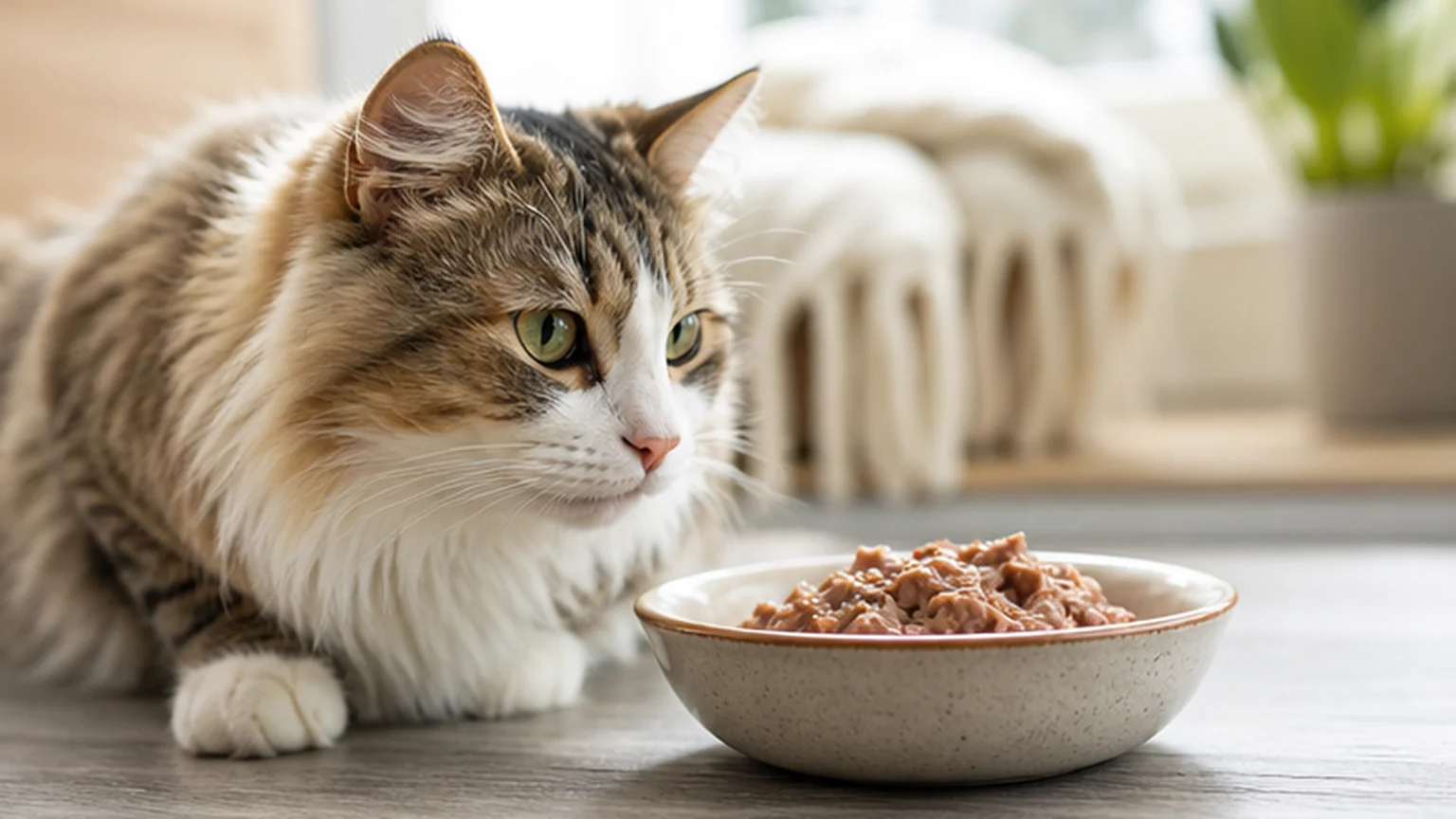
The short answer
There is no single “best” wet cat food that works for every cat. The best wet cat food for your cat is one that is nutritionally complete and balanced for your cat’s life stage, from a company you trust, and one your cat enjoys and tolerates. Start by finding the AAFCO nutritional adequacy statement on the label, usually a line that says the food is “complete and balanced” for adult maintenance, growth, or all life stages. If that line is missing, the food is not meant to be a main diet. After that, consider the protein source, calorie content, moisture level, and your cat’s preferences. The label is the most reliable tool you have.
Why wet food deserves a place in your cat’s bowl
Cats evolved from desert hunters and naturally have a low thirst drive. Even healthy cats often do not drink enough, especially if they eat dry food only. Wet food has a moisture content of about 75–80%, so it gives cats a meaningful amount of water with each meal. That extra water supports normal urinary health and helps keep urine diluted, which can be helpful for cats prone to urinary or kidney concerns. If your cat already has a medical condition, your veterinarian should guide the choice.
Wet food is usually lower in carbohydrates and calories per bite than kibble, which can make portion control easier for indoor cats. It is also highly fragrant and tasty to many cats, making it a great option for picky eaters. On the downside, wet food spoils if left out, tends to cost more per calorie, and can be messy. It is not automatically better than dry food; a low-quality wet food is still low-quality. What matters is the nutrient profile and how well the food fits your cat’s life.
The label checklist: what actually matters
The label is where most of the useful information lives. Ignore front-of-package marketing and go straight to the small print.
1. AAFCO statement
The most important part of a pet food label is the nutritional adequacy statement. In the U.S., the Association of American Feed Control Officials sets nutrient profiles for cat foods. Products can carry a statement such as “formulated to meet the nutritional levels established by the AAFCO Cat Food Nutrient Profiles” or “animal feeding tests using AAFCO procedures substantiate that this food provides complete and balanced nutrition.” Feeding tests are ideal, but many good foods use formulation statements. If a food has no AAFCO statement, treat it as a treat, not a daily diet.
2. Life stage
Kittens, adults, and senior cats have different nutritional needs. Kittens need more protein, energy, calcium, and phosphorus than adult cats. Adult maintenance foods are designed for typical adults. “All life stages” foods meet the stricter growth requirements, so they can be too calorie-dense for a less active adult. Choose a product that matches your cat’s current life stage unless your veterinarian suggests otherwise.
3. Guaranteed analysis
The guaranteed analysis lists minimum crude protein, minimum crude fat, maximum fiber, and maximum moisture. It doesn’t show ingredient quality, but it gives you a rough idea of what the food provides. Most wet foods supply around 8–12% protein and 5–8% fat on an “as fed” basis, but these numbers vary widely. More important than comparing one number to another is checking that the food is complete and balanced, and that your cat maintains a healthy body condition on it.
4. Calories
Wet food can range from about 70 to more than 200 calories per can. Always look for the calorie statement (kcal per can and per kilogram). This is the number that lets you compare different products and portion your cat’s meals fairly. If you don’t know how many calories your cat needs, ask your veterinarian or start with the feeding guidelines on the package and adjust based on your cat’s weight and body condition.
Here is a quick reference for reading labels:
| Label element | What to look for | Why it matters |
|---|---|---|
| AAFCO statement | “Complete and balanced” plus the life stage | Confirms the food meets minimum nutritional requirements |
| Life stage | Kitten, adult, or all life stages | Matches protein, fat, and mineral needs to your cat’s age |
| Animal protein source | Chicken, turkey, salmon, beef, etc., early on the list | Supplies essential amino acids such as taurine |
| Moisture | Around 75–80% for wet food | Supports hydration and urinary health |
| Calories | Clear kcal per can and per kg | Helps you feed the right amount for your cat |
Ingredients: what to look for and what to ignore
The ingredient list tells you about the sources of nutrients, but it is not the same as a nutrient profile. Ingredients are listed by weight, and because wet food is mostly water, the first ingredient is often water or broth. That’s not a red flag. Look for a named animal protein such as chicken, turkey, salmon, or beef among the first few ingredients. Named proteins are easier to understand and give you confidence the food is animal-based.
Do not be afraid of by-products. In AAFCO-regulated foods, by-products are nutrient-rich organ meats such as liver and kidney. They are digestible and can provide taurine and other valuable nutrients. Terms like “natural,” “premium,” “holistic,” and “human-grade” are marketing words, not quality guarantees. Grain-free is also not a plus for healthy cats; cooked grains and other carbohydrates can be perfectly digestible energy sources. The whole food, not a single ingredient, matters most.
How to choose for your individual cat
Your cat is not a generic cat, so the best wet food should fit your animal’s age, weight, and preferences.
Age and lifestyle
Feed kittens a growth formula until about one year of age. Adult cats usually do well on an adult maintenance formula. If you have a very active, lean cat, an all-life-stages food may be appropriate; for a relaxed indoor cat, a calorie-controlled adult food is usually a better match. Adjust as your cat changes.
Health conditions
Wet food can help with hydration, but it is not a medicine. If your cat has a medical condition—kidney disease, diabetes, urinary issues, allergies, or anything else—your veterinarian is the one to design a diet. Some conditions are managed with specific therapeutic diets, and changing diets on your own can be risky.
This article provides general nutrition information, not a prescription. If your cat has a health condition, ask your veterinarian for a diet plan tailored to your cat. Do not switch to a therapeutic diet—or stop one—without veterinary guidance.
Palatability and tolerance
Even the best food on paper is useless if your cat won’t eat it. Try small cans or single-serving pouches first. Introduce a new food gradually by mixing it with the old food over about seven days. Some cats are sensitive to sudden changes and may develop a soft stomach. If your cat is consistently ignoring the new food or showing tummy upset, choose a different flavor or texture. Patience often pays off.
Budget
You can feed a nutritionally complete wet food without buying the most expensive can. A solid mid-range brand with an AAFCO statement is a fine daily choice. You may also mix wet and dry food to manage cost while still offering extra moisture. The key is consistency: the best diet is one you can afford to feed every day.
Frequently Asked Questions
Is wet food better than dry food?
Not universally. Wet food provides more moisture, while dry food is more convenient and sometimes helps with dental plaque (though the effect is modest). Many cats thrive on a combination of both. The best choice depends on your cat’s water intake, calorie needs, and preferences.
How can I tell if a wet cat food is “complete and balanced”?
Find the AAFCO nutritional adequacy statement on the can or package. It should say the food is either formulated to meet AAFCO nutrient profiles or substantiated by feeding trials. That statement is the minimum bar for a food to be a cat’s main diet.
Should I choose grain-free wet food?
Not for most cats. Grain-free is a marketing term, not a sign of healthier nutrition. Unless your veterinarian has diagnosed a specific intolerance or allergy, cooked grains are not a problem for cats. Research has not proven any benefit to grain-free diets for healthy cats, and some concerns exist about certain grain-free diets in dogs.
Can kittens eat adult wet food?
No. Kittens need a growth formula because they require more protein, calories, calcium, and phosphorus. Feeding an adult-maintenance food to a kitten can lead to nutrient deficiencies. Keep kittens on a kitten-specific food until about one year of age, or as recommended by your vet.
Can I mix wet and dry food?
Yes. Mixing wet and dry food can combine moisture and palatability with convenience and cost savings. Just make sure both foods are complete and balanced for your cat’s life stage, then add their calories together so you don’t accidentally overfeed.
Key Takeaway
The best wet cat food is the one that is complete and balanced for your cat’s life stage, made by a reputable company, and something your cat actually enjoys eating. Use the AAFCO statement as your starting point, read the calorie and guaranteed-analysis information, and let your veterinarian tailor the details to your cat’s health. Skip the marketing hype, trust the label, and your cat will be well nourished.
Share this guide
Help another cat parent find it.