Use this as a starting estimate
A calorie result is an estimated starting range, not a prescription. Adjustments may be needed for body condition, age and life stage, neuter status, activity, medical conditions, food calorie density, and weight trend over time.
The short answer
An automatic feeder is usually better for scheduled, measured meals. A gravity feeder is simpler but keeps food available and can make intake harder to track. Either option must fit the cat, food, and household.
Neither feeder replaces daily observation. A machine can dispense food without proving that the cat ate it, and a full hopper does not guarantee that food is moving freely.
Automatic vs. Gravity Feeder Comparison
| Consideration | Automatic feeder | Gravity feeder |
|---|---|---|
| Delivery | Timed or programmed portions | Refills the bowl as food is eaten |
| Portion control | Better when portions are calibrated | Limited; food stays available |
| Meal timing | Scheduled | Continuous access |
| Power | Battery, mains, or both | Usually none |
| Failure points | Programming, motor, power, jams | Jams, bridging food, blocked chute |
| Cleaning | Multiple removable parts | Hopper and bowl |
| Multi-cat use | One cat may steal another's meal | Individual intake is difficult to know |
| Best fit | Measured schedules and small meals | Cats proven to self-regulate from open food |
| Travel | Helpful but still needs human checks | Simple but still needs human checks |
How Automatic Feeders Work
Automatic feeders release food at programmed times or in selected portions. Hopper models usually dispense dry food through a motor, while rotating tray models may hold individual compartments. Some products include cooling features for wet food, microchip access, cameras, or phone controls.
Extra features add convenience but also add parts that can fail. Choose the simplest design that meets the actual need and can be cleaned thoroughly.
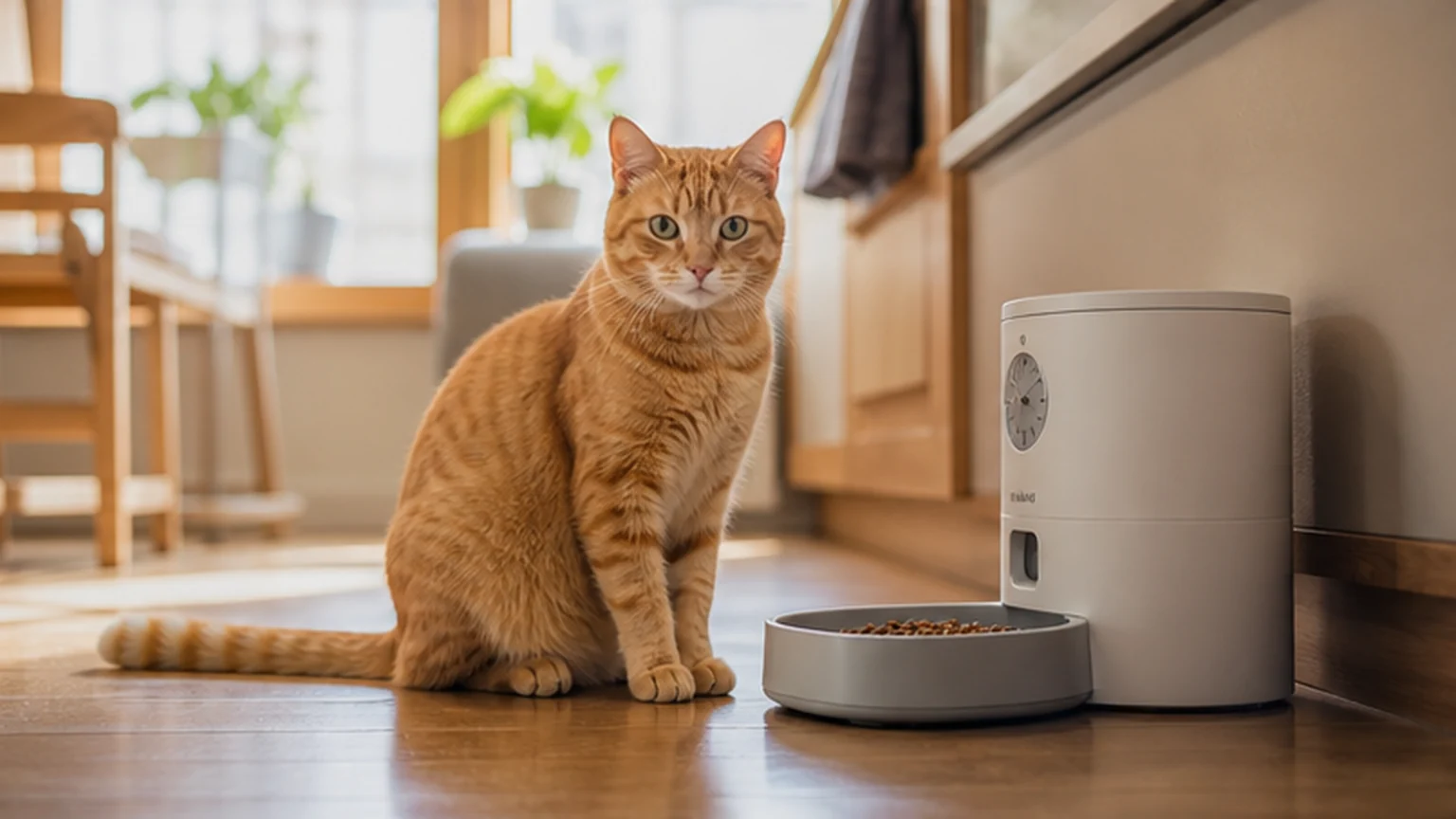
Automatic feeders
Look for reliable portion settings, easy cleaning, a backup power plan, and a design that prevents one cat from taking another's meal. Test the schedule while you are home before relying on it during travel.
Advantages
- Divides one daily allowance into scheduled meals.
- Can serve early, overnight, or workday portions.
- Helps separate meal timing from a person waking or arriving home.
- May slow intake when small amounts are dispensed across the day.
- Some microchip models restrict access to an assigned cat.
Trade-Offs
The displayed “portion” may not equal a standard gram amount. Kibble size and shape affect how much a mechanism releases. Motors can jam, clocks can reset, batteries can fail, and phone connectivity can stop.
Automatic feeders may also create noise that startles a cat. A determined cat may tip, pry, or reach into an insecure model. Wet-food feeders need safe temperature control and more careful cleaning.
How Gravity Feeders Work
A gravity feeder holds food above an open bowl. As the cat eats and the level drops, more kibble falls down. It does not measure meals; it keeps the bowl relatively full until the hopper empties or the chute jams.
This simplicity is useful where power is unreliable, but it should not be confused with portion control.
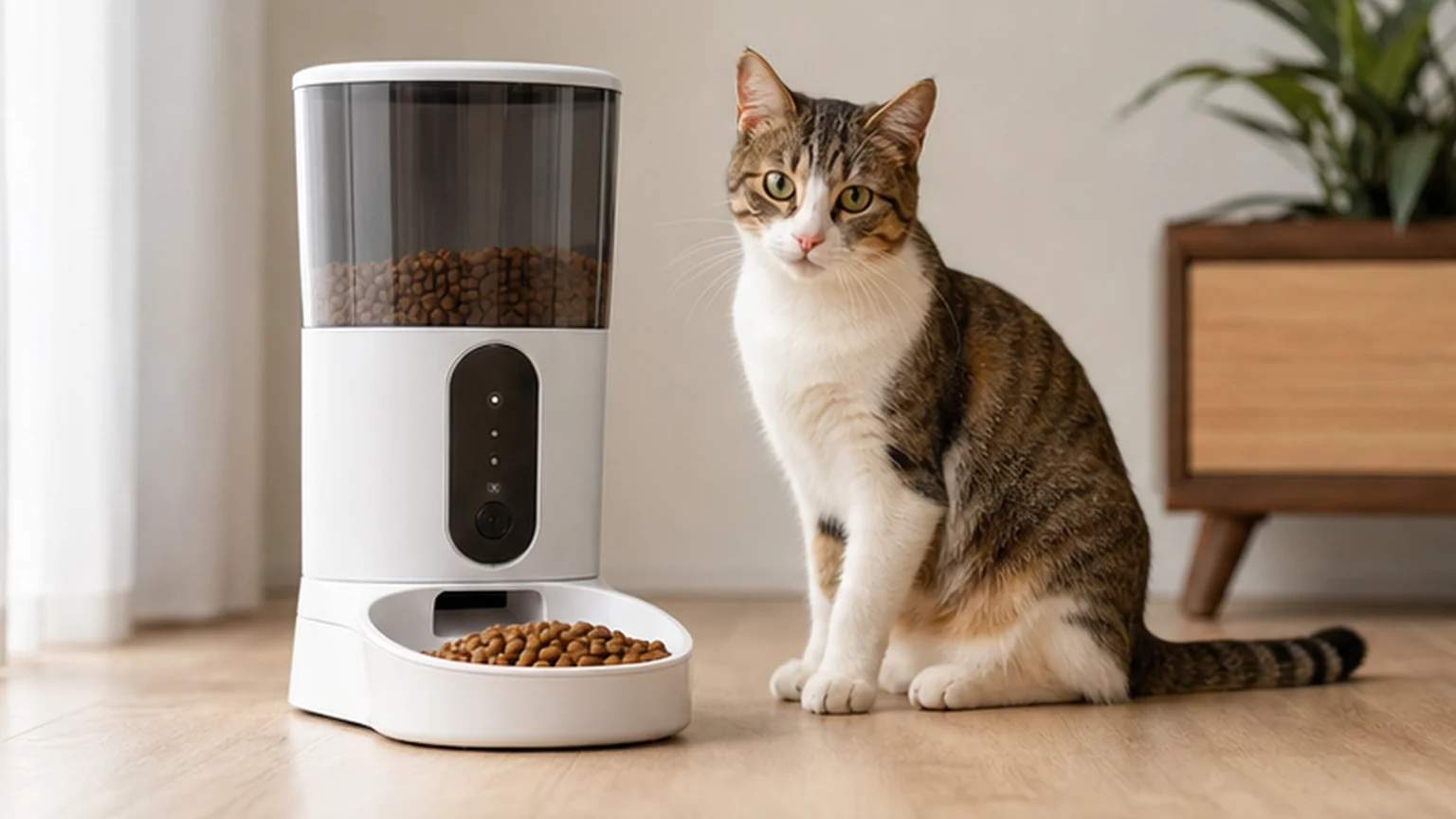
Gravity feeders
Gravity feeders can work for cats that self-regulate, but they make it easier to overfill or miss how much was eaten. They are a poor fit when weight trend or multi-cat access needs close monitoring.
Advantages
- No programming, motor, or electricity.
- Simple operation and generally lower cost.
- Holds more food than a standard bowl.
- Easy to see whether the hopper is running low.
Trade-Offs
Continuous access may not suit a cat who overeats, eats quickly, needs measured weight management, or shares space with another pet. A large hopper can make stale food and residue less visible. Kibble can bridge across a chute while the bowl remains empty.
Because the bowl refills automatically, caregivers may not notice a reduced appetite. In a multi-cat household, there is no clear way to identify who ate how much.
Use the calorie calculator to estimate the daily amount before setting portions.
Start With One Daily Allowance
Calculate or review a reasonable daily calorie estimate, then convert it using the exact food label. Weighing dry food in grams is more consistent than guessing from bowl appearance.
For an automatic feeder, the sum of every programmed meal should equal the planned feeder allowance. If wet food, treats, or training rewards are also provided, subtract their calories first.
For a gravity feeder, you can weigh a daily amount into the hopper, but the device still offers continuous access and leftovers may roll forward. Empty, measure, and record what remains before adding the next day's portion.
Calibrate an Automatic Feeder
Do not trust the factory portion label without testing:
- Fill the feeder with the exact kibble you will use.
- Program one normal dispensing event.
- Dispense into a bowl on a kitchen scale.
- Record the grams.
- Repeat several times to check variation.
- Adjust the schedule based on the average and total daily plan.
Recalibrate after changing kibble size, shape, recipe, or feeder settings. Check the clock after power loss and daylight-saving or time-zone changes where relevant.
Reliability and Backup Planning
Choose a feeder that retains settings after a power interruption or includes battery backup. Replace batteries on a schedule rather than waiting for failure. Inspect the cord for damage and keep it where the cat cannot chew or unplug it.
Even with alerts and a camera, arrange a trusted person to check the cat daily when you are away. They should confirm that food dispensed, the cat ate, water is available, litter boxes are normal, and the cat appears well.
Keep instructions and a manual feeding plan visible. A backup person should know how to open, clean, reset, or bypass the feeder.
Cleaning and Food Freshness
Wash bowls and removable food-contact parts according to the manufacturer's directions. Crumbs and oils collect in hoppers, chutes, rotating mechanisms, and seals. Empty old food before adding a new bag rather than continually topping up.
Dry every part completely before refilling. Moisture inside a hopper can damage food and mechanisms. Keep the original food bag or record product and lot information.
For wet-food feeders, follow temperature and time guidance closely. Cooling packs and compartments must be cleaned and prepared correctly; a timer does not make wet food safe indefinitely.
Multi-Cat Households
A standard timed feeder does not prevent the fastest cat from eating every portion. Feed in separate rooms, supervise meals, or consider microchip-controlled access. Test recognition and door movement while you are home, because some cats are startled and others learn to follow an authorized cat.
Gravity feeders are especially poor at showing individual intake. Several gravity feeders in the same room can still be shared or guarded. Separation and observation are more reliable than simply increasing the number of hoppers.
Which Feeder Fits Your Cat?
Choose an automatic feeder when:
- a measured schedule is important;
- several small meals are useful;
- early or overnight timing is difficult;
- the cat eats dry food compatible with the mechanism; and
- the household can calibrate and maintain the device.
Consider a gravity feeder only when:
- continuous access is intentionally chosen;
- the cat has demonstrated stable self-regulation;
- individual intake does not need close tracking;
- no other animal steals the food; and
- the hopper and bowl can be checked and cleaned daily.
A standard bowl may be better than either option when you are home for meals, need to watch appetite closely, serve wet food without a suitable timed tray, or have a cat that fears mechanisms.
Common Feeder Mistakes
- Programming servings without weighing what is dispensed.
- Adding treats and wet food on top of the full feeder allowance.
- Assuming a large hopper cannot jam.
- Leaving for a trip without days of home testing.
- Relying on an app instead of a human check.
- Using one open feeder for cats with different portions.
- Topping up old kibble indefinitely.
- Ignoring a sudden change in appetite because the machine ran.
Feeder changes do not replace veterinary advice for weight loss, diabetes, medication schedules, or a cat that stops eating.
Seek veterinary guidance for a planned weight-loss diet, growing kitten, pregnancy, diagnosed condition, unexpected weight change, or meaningful appetite change. If a cat stops eating or eats much less than usual—especially with vomiting, weakness, pain, breathing changes, or other signs—do not wait for the next programmed meal.
Frequently Asked Questions
Can an automatic feeder help with early-morning waking?
It can separate a measured early meal from your getting out of bed. Keep the daily total unchanged and adjust timing gradually.
Can I use an automatic feeder for wet food?
Only use a product designed for it, with temperature control and handling that follows its instructions. Test food temperature and reliability while home.
Is a gravity feeder safe for a weekend away?
It can jam, spill, become contaminated, or be emptied by one cat. Cats still need reliable human checks, fresh water, litter care, and observation.
Are microchip feeders worth it?
They can help control access in multi-cat homes, but they require training, correct setup, maintenance, and observation. They do not decide the correct portion.
Key Takeaway
Automatic feeders are generally the stronger choice when timing and measured portions matter; gravity feeders mainly provide continuous access with fewer mechanical parts. Calibrate any dispenser using the exact food, maintain and clean it, provide a failure plan, and keep a person in the loop. The feeder delivers the plan—it does not create or monitor it.
Read feeding frequency and the feeding guide.
Estimate your cat's daily calorie range
Use PurrWise's calculator for a practical starting estimate, then compare it with body condition and weight trend.
Sources & Scientific References (3)
Share this guide
Help another cat parent find it.