The short answer
There is no single "right" amount that fits every senior cat, but a reasonable starting point is about 40 to 50 calories per kilogram of healthy body weight per day. For a typical 4.5 kg (10 lb) cat, that comes to roughly 180 to 225 calories daily — about two-thirds of a cup of a dry food with 350 calories per cup, or one to one-and-a-quarter average 200 kcal cans of wet food.
Your cat's true requirement depends on the calorie density of the food, her activity level, how much muscle she has left, and any medical conditions she lives with. So the path to the right portion is a short calculation plus a good monitoring habit: estimate, measure, weigh weekly, and adjust. If you notice a sudden change in appetite or body weight, check with your veterinarian first — in a senior cat, those changes are often a health clue, not just a portion problem.
What counts as a "senior" cat?
Veterinarians don't rely on a single birthday to define "senior." The 2021 AAFP/AAHA Feline Life Stage Guidelines use three late-life stages: mature (7 to 10 years), senior (11 to 14 years), and geriatric (15 years and older). A cat's calorie needs don't suddenly drop the day she turns 11, so treat these labels as a loose framework rather than a switch.
Still, aging brings real changes that affect how much food is right:
- Most cats become less active, so daily energy burn declines.
- Muscle mass slowly shrinks — a process called sarcopenia — which makes high-quality protein more important.
- Sense of smell and taste can dull, so strongly aromatic food often appeals more.
- Dental pain, arthritis, and digestive changes can alter how much a cat eats at each sitting.
- Common conditions of older cats, including chronic kidney disease and hyperthyroidism, can either suppress or increase appetite.
That last point is why feeding advice for seniors is rarely a one-time answer. The right amount shifts as health changes, and monitoring matters more than math.
How to estimate how much to feed: a step-by-step approach
Step 1: Know your cat's healthy body weight. If you can, get an exact weight at a vet visit. At home, a bathroom-scale trick works: weigh yourself alone, then weigh yourself holding your cat, and subtract. Repeat this monthly.
Step 2: Calculate a calorie range. For a healthy, mostly indoor senior cat, a common maintenance estimate is 40 to 50 kcal per kg of body weight per day. Use the target weight — what your cat should weigh — not the scale reading if she is overweight.
Step 3: Find the calorie density of the food. Look for "kcal per cup," "kcal per can," or "kcal per kg" on the label or the manufacturer's website. This number is the key that converts a calorie target into a portion size.
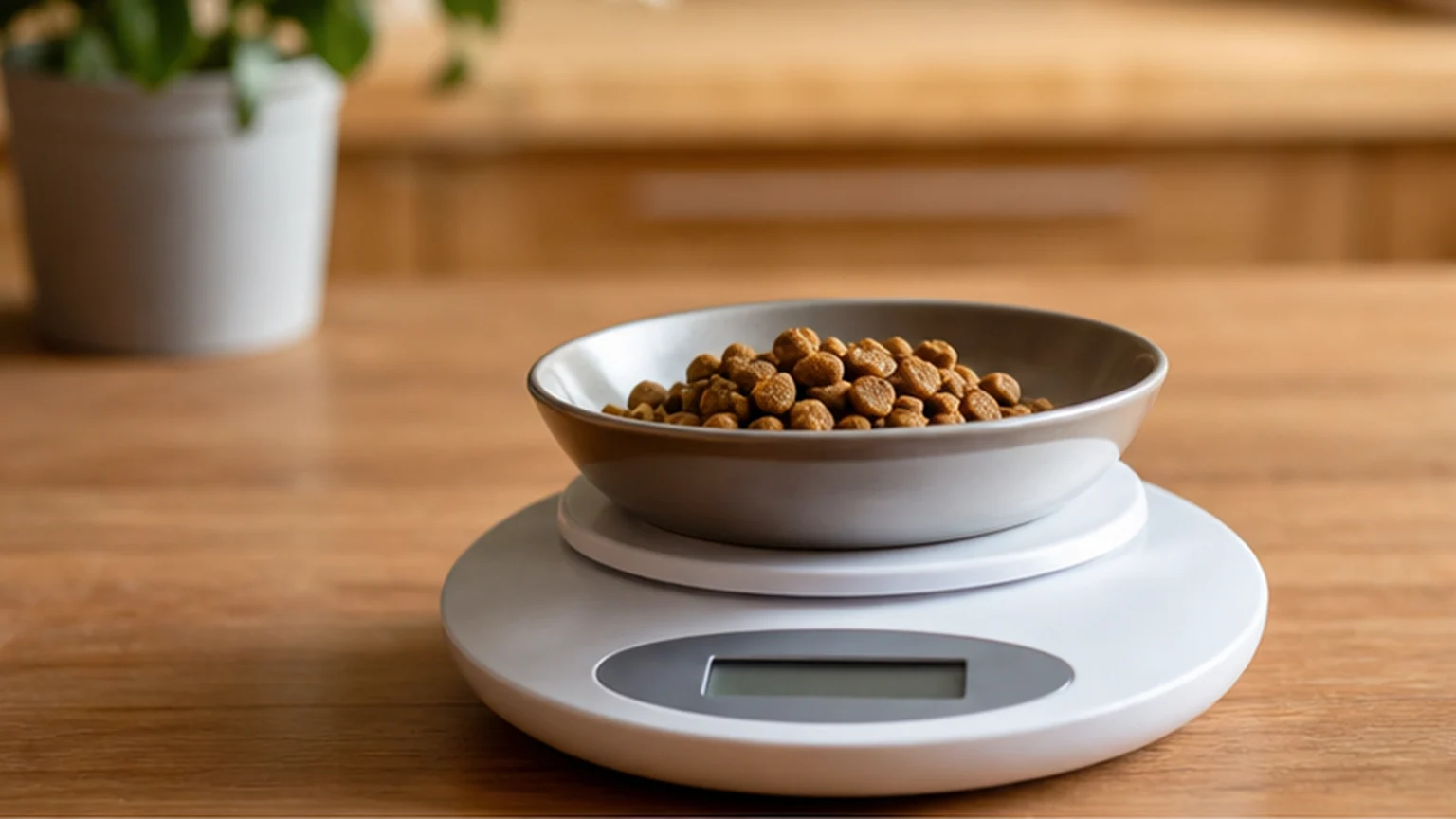
Step 4: Divide and measure. Divide the daily calorie range by the food's calories per serving, then portion it by weight with a kitchen scale at least once to see what an accurate serving actually looks like.
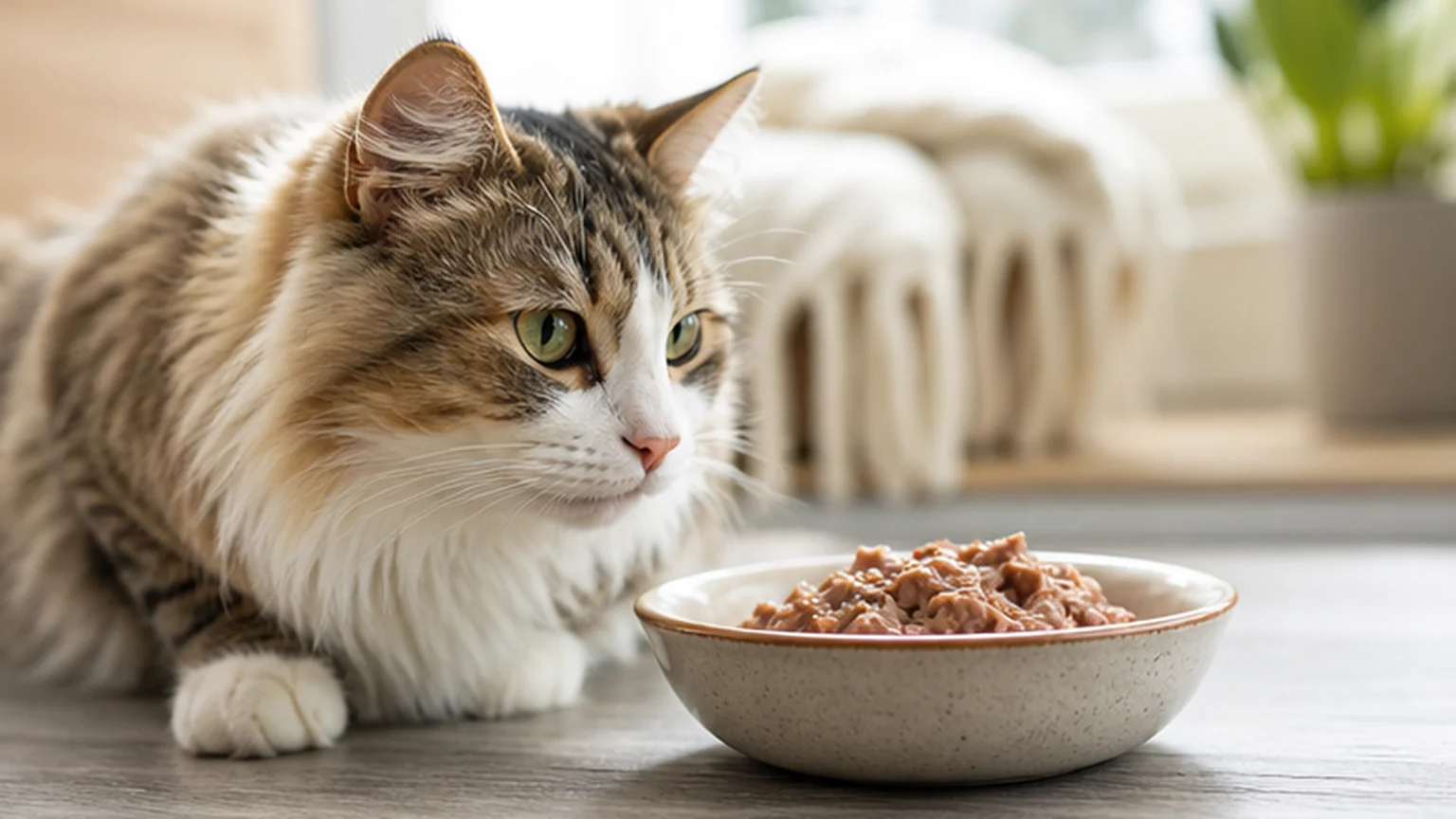
Example: a 4.5 kg (10 lb) cat needs about 180 to 225 kcal daily. If her dry food contains 350 kcal per cup, that's about half to two-thirds of a cup per day. If she eats canned food with 200 kcal per can, that's about one to one-and-a-quarter cans.
Approximate daily calories for senior cats
The table below gives rough starting ranges for a healthy, indoor senior cat at a healthy weight. Your cat may legitimately need up to 20% more or less.
| Healthy body weight | Daily calorie range | Dry food example (350 kcal/cup) | Wet food example (200 kcal/can) |
|---|---|---|---|
| 3.6 kg (8 lb) | 150–200 kcal | 1/2–2/3 cup | 3/4–1 can |
| 4.5 kg (10 lb) | 180–225 kcal | 1/2–2/3 cup | 1–1.25 cans |
| 5.4 kg (12 lb) | 220–270 kcal | 2/3–3/4 cup | 1.25–1.5 cans |
| 6.8 kg (15 lb) | 270–340 kcal | 3/4–1 cup | 1.5–1.75 cans |
These examples assume a dry food with about 350 kcal per cup and a canned food with about 200 kcal per can. Real products vary widely: dry foods range from roughly 300 to 500 kcal per cup, and cans from 150 to over 250 kcal each. When in doubt, use the number printed on your bag or can.
Read the label like a skeptic
Every food label includes a feeding chart, but most are written for an "average adult cat" — typically a younger, moderately active cat — so they are often too generous for a couch-loving senior. Two details matter more than that chart: the calorie number and the "complete and balanced" statement.
Calorie density explains why two foods can have very different portion sizes. A 400 kcal/cup kibble needs far less volume than a 320 kcal/cup kibble to deliver the same calories. Protein also becomes more important with age because seniors lose muscle mass; choose a complete-and-balanced food your cat actually eats willingly rather than assuming a bag labeled "senior" is automatically superior — the term is not strictly regulated.
Finally, measure in grams, not cups. Scoops vary; a digital kitchen scale removes guesswork. An extra 10 grams a day doesn't sound like much, but it equals roughly 450 extra calories over a month.
Adjusting for common senior situations
Weight gain. Reductions in activity and metabolism can tip some seniors into overweight. Trim portions by 10 to 15%, measure every meal, and limit treats. If you currently free-feed, moving to timed meals makes it possible to know exactly what is eaten.
Weight loss. Some seniors lose weight even while eating normally. Before adding extra calories, get a veterinary workup — hyperthyroidism, chronic kidney disease, diabetes, and dental disease can all cause weight loss. Once medical causes are ruled out, a slow increase of 10 to 20% of daily calories can help, ideally with veterinary input.
Medical conditions. Kidney disease, diabetes, allergies, and other conditions may call for specific therapeutic diets. Those decisions belong in the exam room — a diet change made on a hunch can do real harm.
The portions in this article are starting estimates for healthy senior cats. They are not prescriptions. If your cat has a medical condition, takes medication, has lost or gained more than 5% of her body weight in a month, or has gone more than 24 hours without eating, contact your veterinarian before changing her food. Whenever you do change diets, transition gradually over 7 to 10 days to avoid digestive upset.
Monitor: the weekly weigh-in habit
The most reliable way to find the right portion is a simple monitoring routine.
- Weigh your cat every week or two on the same scale. A baby scale is easiest; with a bathroom scale, use the subtract-your-weight method.
- Check body condition. You should be able to feel the ribs easily under a light fat layer, and there should be a subtle waist when viewed from above. Most 9-point body-condition charts put the ideal at a score of 5.
- Keep a small food diary: how much is offered, how much is left, and whether appetite changes.
- Treat red flags seriously: eating less than half a normal meal for more than a day, drinking much more than usual, vomiting, or any large weight shift in either direction.
Frequently Asked Questions
Do I need to switch my senior cat to a "senior" formula?
Not automatically. The word "senior" is not strictly regulated, and a high-quality adult-maintenance food can be perfectly appropriate. What matters more is that the food is complete and balanced, contains good protein, is palatable, and keeps your cat at a healthy weight. If she thrives on her current food, a switch is unnecessary; any change should happen gradually.
My senior cat eats the same amount but keeps losing weight. What should I do?
See the veterinarian before adding calories. Unexplained weight loss in an older cat is a classic clue to hyperthyroidism, kidney disease, diabetes, or dental problems. Feeding more now can mask those signs. After a workup, your vet can help you increase calories safely.
Is free-feeding okay for a senior cat?
It works for some cats who naturally stop when full, but it makes it hard to know how much is actually eaten — and that number is your best monitoring data. If you free-feed, measure what you put down and only refill when empty. Better still, serve two or three measured meals so appetite changes become obvious.
How many meals a day should a senior cat get?
Most do well with two to three meals, and some prefer smaller, more frequent meals of four per day, especially if they have dental pain. The total daily calories matter more than the schedule, so once you set the total, split it in a rhythm your cat eats well.
Key Takeaway
The right portion for a senior cat is a moving target, but the method is simple: estimate 40 to 50 kcal per kilogram of healthy body weight, convert that to food using the label's calorie density, measure accurately, weigh your cat weekly, and adjust in small steps. Let appetite and weight changes prompt a veterinary visit rather than guesswork, and you will keep your senior fed well for years to come.
Share this guide
Help another cat parent find it.