The short answer
Your cat smells your breath because, to a feline nose, your breath is a live news feed. It carries your personal scent signature, traces of your last meal, echoes of the places you've been, and subtle signals about how you're feeling. Cats read the world through scent the way humans read it through sight, and your face happens to sit right at nose level during cuddles, conversations, and pillow talk. When your cat leans in to sniff your mouth, they are not being odd or invasive — they are saying hello, catching up, and confirming you are still the same person they bonded with. It is feline social networking, and honestly, it means your cat finds you worth investigating.
Your breath is a scent bulletin board
Every exhale releases a stream of microscopic molecules, and for a cat those molecules are loaded with meaning. Smell is a cat's most powerful sense. A feline nose contains roughly 200 million odor-detecting cells, compared with about five million in humans, and cats have an extra tool we lack: the vomeronasal organ, sometimes called Jacobson's organ, located in the roof of the mouth. When you see a cat wrinkle their nose, open their mouth slightly, and stare off into space, they are performing what behavior experts call the flehmen response — a way of pulling scent molecules across that special organ to get a more complete "read" of the odor.
Breath is especially interesting to cats because it comes from inside the body. That means it carries not just the outside smells you collected during the day but also internal scent signals tied to how your body is running. To a cat, your exhale is a bulletin board with fresh updates on the most important resident in their territory — you. The short sniff you notice is really a concentrated information download, and cats are excellent at it.
How cats smell: a superpower nose
A cat's nose is built for detail. Beyond the sheer number of scent receptors, their brains dedicate a large share of processing power to decoding odors. Cats use these skills constantly: they identify other cats and people by scent, detect the presence of strangers in the house, find food, recognize safe resting spots, and monitor their territory for changes. Scent is the glue of their social world.
When your cat presses their nose toward your face, they are running a rapid set of checks. Are you familiar? Do you smell like any other animals? Is there anything new worth investigating? The whole sequence can take less than three seconds, and once their questions are answered, they will usually move on to the next activity — grooming, head-bunting, or asking for dinner. The table below shows some common signals to look for during a breath-sniffing session.
| Signal | What it usually means | Your move |
|---|---|---|
| Relaxed ears, soft eyes, slow sniff | Friendly information gathering | Stay still and let them finish |
| Sniff followed by a slow blink | Comfort and trust | Slow-blink back |
| Sniff followed by head-bunting or cheek rubbing | Scent exchange and bonding | Offer a hand for a chin rub |
| Flat ears, lashing tail, backing away | Overwhelmed or unsure | Give them space immediately |
| Puffed tail and tense body | Startled or alarmed | Stop the interaction and move away slowly |
The food-smell factor
Cats are obligate carnivores, which means their bodies are designed to run on animal protein, and their noses are finely tuned to detect it. When you eat something meaty — chicken, fish, eggs, even broth-based soup — the aromatic compounds linger in your mouth and on your breath. To your cat, you do not just say "I had salmon for lunch." You briefly become the packaging for salmon. That is hard for a curious cat to ignore.
This is not the same as begging. Food-motivated sniffing is a quick, practical check: what is this, and is any available? Cats who have learned that certain smells lead to their own food bowl may sniff your breath and then hurry toward the kitchen, connecting your scent to dinnertime. It is associative learning at work, not a ploy to steal your sandwich. And because cats are individuals, some will barely react to food smells while others will follow you around for minutes. Both are normal.
A greeting and a bond
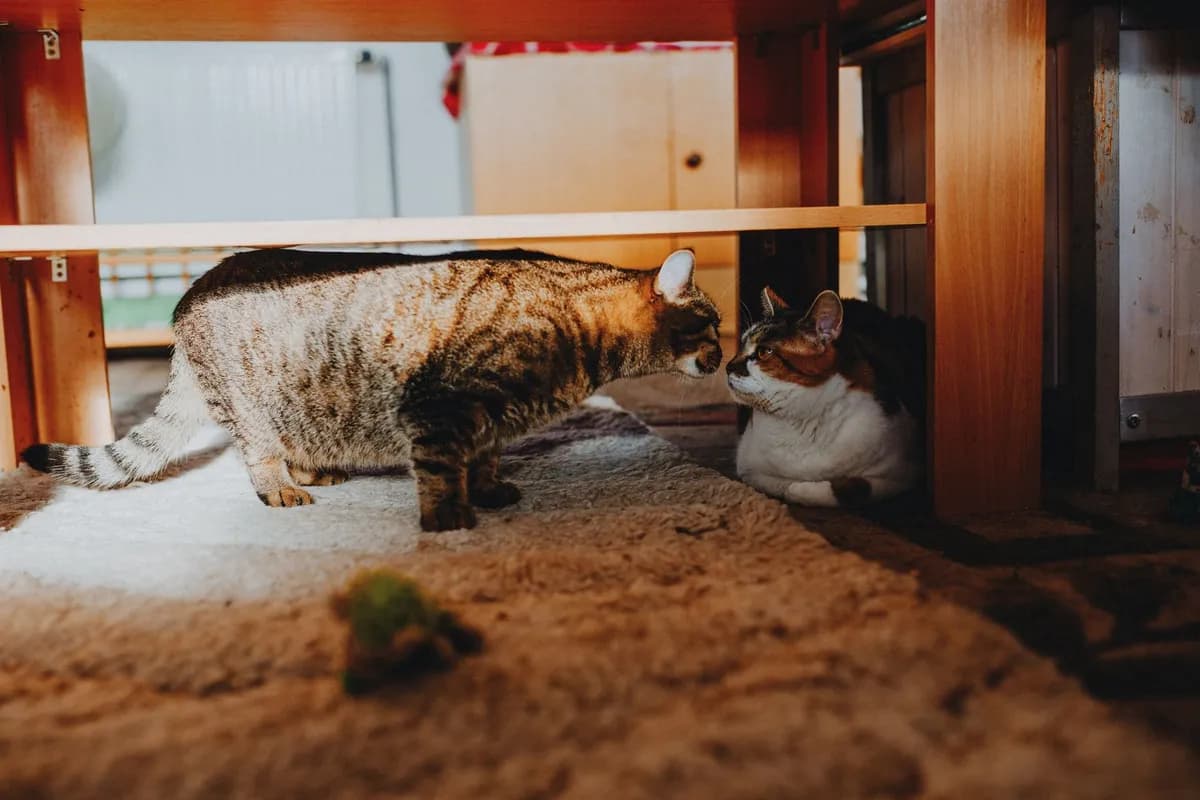
Cats greet familiar companions with nose-to-nose contact. Mutual sniffing is how they confirm identity, exchange information, and re-establish their social connection after time apart. When your cat stretches toward your mouth, they are applying that same social script to you — and it is a flattering one. It means they classify you as part of their inner circle, someone worth recognizing personally rather than a background feature of the house.
The sniffing often continues into other bonding behaviors. You may notice your cat sniff your breath, then press their forehead or cheek against yours. That head-bunting leaves pheromones behind, but it also picks up your scent, blending the two into a shared family scent. This is the same reason cats rub against each other in multi-cat households. A breath sniff plus a head-bunt is essentially your cat's version of a warm hug with a handshake.
Mouth odors as information gathering
Cats are exquisitely sensitive to change. Your breath has a stable baseline — the familiar scent of you — so any variation stands out immediately. After a meal, after exercise, when you are stressed, when you have been around other animals, or when you've come home from a day out, your breath carries fresh material. Cats naturally investigate novelty; it is how they stay informed. A change in your scent profile is not alarming to them. It is simply new information, and curiosity is one of their strongest instincts.
It is important to be clear about what this is not. Your cat is not performing a health assessment. While popular stories sometimes suggest that animals can sense illness, a cat sniffing your face is far more likely to be checking your scent for "what happened today" than for "what is wrong internally." Cats respond to what smells different, not to medical diagnoses.
Cats are not medical detectors, and a breath smell that changes is not a diagnosis for either of you. If your own breath suddenly changes or you're concerned about it, see your dentist or doctor. If your cat develops persistent bad breath, that deserves a veterinary visit — dental disease is one of the most common problems behind it. A quick sniff is normal behavior; relying on it as a health check is not.
What your cat is (and isn't) telling you
So what should you do when your cat wants a breath sniff? Most of the time, the answer is simple: let them. Allow your cat to initiate the interaction, and avoid shoving your face toward them. A friendly alternative is offering the back of your hand or a knuckle at nose level, which gives them a convenient scent target without crowding them. If your cat sniffs and then pulls away, respect that — they got the information they wanted, and pushing the interaction can make them feel trapped.
A breath sniff is also a chance to read the rest of their message. If your cat sniffs and then slow-blinks, they are comfortable. If they sniff and immediately rub against you, they are reinforcing your bond. And if they sniff and leave, no offense taken. They were just checking the news. What the sniff is not: an act of aggression, a demand, or a judgment of your hygiene. It is information-gathering with someone they trust.
Frequently Asked Questions
Why does my cat smell my breath and then turn away?
They were not offended — they were satisfied. Cats gather what they need in a few seconds. Turning away simply means the information has been filed and they have moved on to their next decision, which is usually a nap.
Why does my cat put their nose right into my mouth?
Some cats want to get even closer to the source, especially if the smell is very interesting. It is still friendly curiosity, but you do not have to allow it. Gently turning your head away and offering a finger or the back of your hand gives them a more hygienic target. If they persist, schedule the sniff for times your mouth is closed.
Why does my cat smell my breath after I eat?
Food aromas cling to your mouth and nose. For a cat with a highly sensitive nose, you smell like the meal itself. They are checking out what you ate and whether there is any chance it involves them.
Is it safe to let my cat smell my breath?
Yes, in general. Let them approach on their own terms, keep your lips closed, and don't restrain them. If your cat is tense, anxious, or in pain, they may react defensively to a face being near theirs, so always let the cat set the distance.
Does my cat smell my breath because they love me?
It is connected to bonding. Cats use nose-to-nose sniffing with the individuals they trust. Your breath sniff is part of the same social greeting behavior, so affection is definitely on the list — along with food, curiosity, and the simple need to know what you've been up to.
Key Takeaway
When your cat smells your breath, they are doing something natural, intelligent, and affectionate: reading the most detailed scent report available in their world — you. It is a sign of trust, curiosity, and social belonging, rooted in a sense of smell far more powerful than ours. Let the sniff happen on your cat's terms, enjoy the slow blink that often follows, and treat the moment as what it really is: your cat catching up with the person they care about most. In a world full of confusing sights and sounds, your scent is home.
Share this guide
Help another cat parent find it.