The short answer
Your cat rubs against your legs to leave scent behind — and to read the scents you've carried home. Cats have scent glands on their forehead, cheeks, chin, tail, and paws, and rubbing deposits chemical messages that mark you as part of their inner group. In cat language, this behavior (often called bunting or allorubbing) is a friendly greeting, a territorial signature, and a way to gather information all at once. When your cat weaves between your legs, they're not just demanding food or attention (though they may have learned that rubbing gets them those things). They're telling the whole group, This human is one of us.
The scent kit: what your cat is actually applying
Cats are walking scent factories. Concentrated scent-producing glands sit at specific spots: the cheeks, the chin, the forehead, the base of the ears, along the flanks and tail base, and between the paw pads. When your cat presses those areas against your leg, they release pheromones — chemical signals that are invisible to humans but rich with meaning to cats.
These pheromones form what behaviorists call a scent landscape. Everything in your cat's safe world — their food bowls, their cat tree, their favorite blanket, and you — carries the group scent. When you come home from work, you smell like the outside world: new places, other animals, unfamiliar people. Rubbing re-applies the familiar scent and mixes it with the new, blending your adventures into the family story.
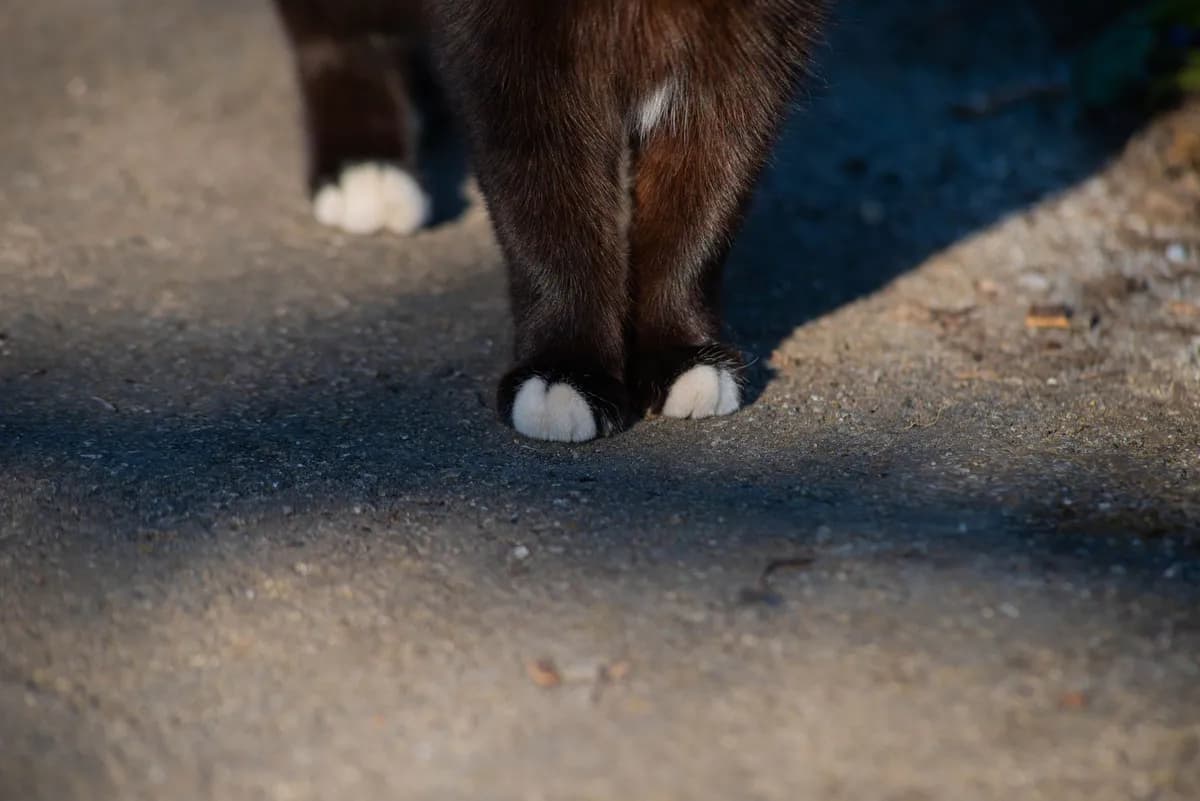
Interestingly, cats also pick up scent as they rub. Their paw pads contain sweat glands that leave a trail everywhere they walk. The next time your cat rubs against you, they're also checking how fresh their previous message is.
The greeting that smells like, well, home
Raised tail, forward ears, a slow weave between your legs — this is the feline equivalent of a warm hello. Cats use scent exchange the way we use handshakes or high fives. It's a social ritual that builds trust and maintains bonds.
Kittens learn this early: mother cats rub their scent on their kittens, and the whole family shares a collective odor. That shared smell has a calming effect — it tells a cat "you're safe, you belong here." When your adult cat rubs on you, they're including you in that family bubble. It's one of the clearest compliments in cat behavior.
Two-way communication: your cat is reading you
Rubbing isn't just writing a message; it's also reading one. As your cat's face and flanks sweep across your legs, their nose picks up a stream of information: where you went, which doorways you passed, whether you petted a dog on your afternoon walk, even faint hints of your stress hormones. A cat's sense of smell is enormously more sensitive than ours, so every errand you run becomes part of the neighborhood's scent story.
This is why some cats greet you with extra enthusiasm after you've been out of the house for a while — or right after a shower, when you've scrubbed your scent away. They're not "reclaiming" you as property; they're re-establishing your shared scent so the world smells correct again.
Why legs, of all places?
Legs are at perfect head height for a typical adult cat, so rubbing is physically effortless. But there are two other reasons built into the design.
First, legs are moving targets — and movement makes the interaction rewarding. The leg weave creates a lively back-and-forth, and most humans respond with attention, pets, or snacks. Cats are excellent learners: the more a behavior reliably leads to a happy owner response, the more a cat repeats it. That's why many cats save their most dramatic leg-weaving for the kitchen, where the connection between "I rub" and "you feed me" was learned years ago.
Second, legs are the body parts that travel through the outside world. They carry the most interesting new scents home — pavement, grass, other pets, strangers — and rubbing lets your cat inspect and overwrite those smells in one pass.
One behavior, several messages
Not all rubbing is identical, and your cat's body language tells you which message you're getting.
| What your cat does | What it usually communicates |
|---|---|
| Slow head bunt against your leg | Warm group-scent greeting; "you're family" |
| Fast cheek rub | Excited hello, often paired with a raised tail |
| Full-body flank rub | Broad territory/scent spread; a confident claim |
| Leg weave in figure-eights | Greeting plus learned routine (often attention- or food-related) |
| Tail wrap around your calf | Social contact layered into the greeting |
The common thread: scent. Frequency and style will shift depending on your cat's mood, their history, and how many other cats share your household. In multi-cat homes, group scent is even more important because it reduces conflict by making everyone smell alike.
When rubbing changes: a note on what to watch
For most cats, rubbing is a calm, occasional ritual that feels like part of daily life. A sudden, dramatic increase in rubbing or other marking behaviors — especially persistent flank rubbing against furniture or walls — can sometimes signal stress, conflict with another pet, or an underlying physical discomfort. It's not your fault, and it's not a sign your cat has "gone bad." It's a clue worth taking seriously.
If your cat's rubbing suddenly becomes constant, frantic, or is paired with other changes in behavior, appetite, or energy, book a veterinary check-up. A sudden shift in scent-marking can be triggered by discomfort as well as emotion. This article provides general information, not medical advice.
Most of the time, though, rubbing is just your cat being a cat.
Enjoying the ritual (and keeping it healthy)
There's no need to discourage normal rubbing — it's healthy, natural, and good for the bond. If you want to make the most of it:
- Let your cat lead. If they rub and then walk away, they were simply greeting you — no need to scoop them up.
- Reward the greeting with a brief chin or cheek scratch — areas where your cat's scent glands sit, so it mirrors the ritual.
- If your cat seems to expect food every time they rub, redirect to a toy or a quick play session now and then so the routine doesn't become a calorie concern.
- Never punish rubbing. It's an innate behavior, and punishing it erodes trust.
A cat who rubs against your legs is a cat who considers you family. Enjoy the compliment — even if it comes with a side of shed fur.
Frequently Asked Questions
Does rubbing mean my cat "owns" me?
Cats don't have the human concept of ownership, but scent exchange does mark you as part of their trusted group. Think of it as a badge of membership rather than a property claim.
Why does my cat rub on me right after a shower?
Because you washed the group scent away. Your cat is restocking you with familiar pheromones so you smell like home again.
Is forehead bunting different from leg rubbing?
Not really — it's the same scent-depositing behavior, just aimed at a taller body part. A head bunt against your face or hand is an especially confident greeting because it puts your cat's most important scent glands close to you.
Why does my cat weave between my legs in the kitchen?
Probably because that's where the learned routine lives: rubbing in the kitchen historically leads to food, or at least to you paying attention. It's a greeting layered with a very practical expectation.
Key Takeaway
When your cat rubs against your legs, they're giving you a scent-based greeting that says: you belong to my group, you're a safe and familiar part of my world. It's a sign of trust, a friendly hello, and a two-way information exchange rolled into one. Pay attention to the rest of their body language, enjoy the ritual, and never punish it — and if the behavior suddenly changes into something constant and intense, a quick check with your veterinarian is the caring next step.
Sources & Scientific References (3)
Feline Behavior — Cornell Feline Health Center
Cornell Feline Health Center • Accessed 2026-01-13
Cat Behaviour — International Cat Care
International Cat Care • Accessed 2026-01-13
Cat Friendly Homes — Cat Behavior Resources
American Association of Feline Practitioners — Cat Friendly Homes • Accessed 2026-01-13
Share this guide
Help another cat parent find it.