The short answer
If you've ever seen a cat transform from sleek to fluffy in a second, you're looking at piloerection. A puffed tail happens when tiny muscles at the base of each hair follicle contract, making the fur stand on end. In cats, this is almost always a sign of high arousal. The most common triggers are fear, startle, and defensive arousal. It can also happen during an exciting game of chase or when a cat feels suddenly threatened. What it is not: a sign of happiness or a casual greeting. A tail held high with a relaxed tip is a friendly hello; a tail that is puffed and rigid tells a different story.
What is a puffed tail, exactly?
Piloerection is the technical name for the hair standing up. It's controlled by the autonomic nervous system, so it's involuntary. When a cat is startled, the same system that prepares the body to fight or flee also activates the muscles that raise the fur. A puffed tail is part of this response.
The effect is often called Halloween cat posture, especially when the cat also arches its back. The raised fur makes the cat look bigger to a potential threat. That visual trick is a classic defensive move. Think of it as the cat saying, I'll look large and scary so you don't come closer.
The tail is a particularly noticeable spot because cats have dense fur there and because the tail is mobile. A puffed tail may be stiff and straight up, or it may curve slightly like a question mark. The rest of the body will tell you which emotion is behind it.
Why do cats puff their tails? The three main triggers
There are three main reasons you'll see a puffed tail: sudden fear, an unexpected startle, and defensive arousal.
Sudden fear
A cat who encounters something genuinely frightening—a loud noise, a strange dog, an unfamiliar person—may puff up. The raised fur is part of the fight-or-flight response. If the fear passes quickly, the tail will usually relax within a minute.
Startle response
A startle is not the same as sustained fear. A door slamming or an object falling can trigger a momentary puff. The cat may jump sideways, hiss, or run a few steps, then recover. This is a reflexive response, so it does not mean your cat has a serious anxiety problem.
Defensive arousal
Sometimes a cat is not scared but is on guard. It might see another cat outside the window, hear an unknown noise, or feel cornered. Defensive arousal is a state of heightened alertness, and the puffed tail is part of the cat's I'm ready signal. This is the context where people sometimes mistake the behavior for aggression. It is true that a defensive cat may escalate to hissing or swatting if the threat does not leave, but the puffed tail itself is not an attack signal; it is a warning to keep distance.
How to read the rest of the body
A puffed tail alone is not enough to tell you what the cat is feeling. Always look at the whole cat:
- Ears: Pinned flat or swiveled sideways suggests fear or defensiveness. Forward ears with wide eyes suggest excitement or intense focus.
- Eyes: Dilated pupils often mean high arousal, whether from fear or excitement. A slow blink is a sign of calm, not arousal.
- Body posture: A hunched, tense body with arched back is defensive. A crouched, low body may mean fear. A playful cat will often bounce or wiggle before pouncing.
- Vocalizations: Hissing and growling point to defensiveness. An excited chirp or a silent focused stare can accompany play.
- Movement: A fearful cat tends to freeze or back away. An excited cat may dart, swat, and pounce.
Here's a quick reference table:
| Signal | Fear/Defensive | Excited/Playful |
|---|---|---|
| Tail | Puffed and rigid, sometimes low or tucked | Puffed but loosely swishing, tip twitching |
| Ears | Flattened or sideways | Forward or slightly flicking |
| Eyes | Wide, pupils large | Wide, pupils large but blinking is possible |
| Body | Tense, arched, leaning back | Bouncy, crouched with rear end up, moving forward |
| Voice | Hissing, growling, yowling | Chirping, silent, occasional meow |
| Movement | Freezing, backing away | Pouncing, chasing, quick sideways hops |
The table makes it clear that fear and excitement can look similar. The key differences are in the ears, body tension, and direction of movement. For a broader overview of tail signals, see the body-language guidance from International Cat Care.
Puffed tail during play: excitement vs. fear
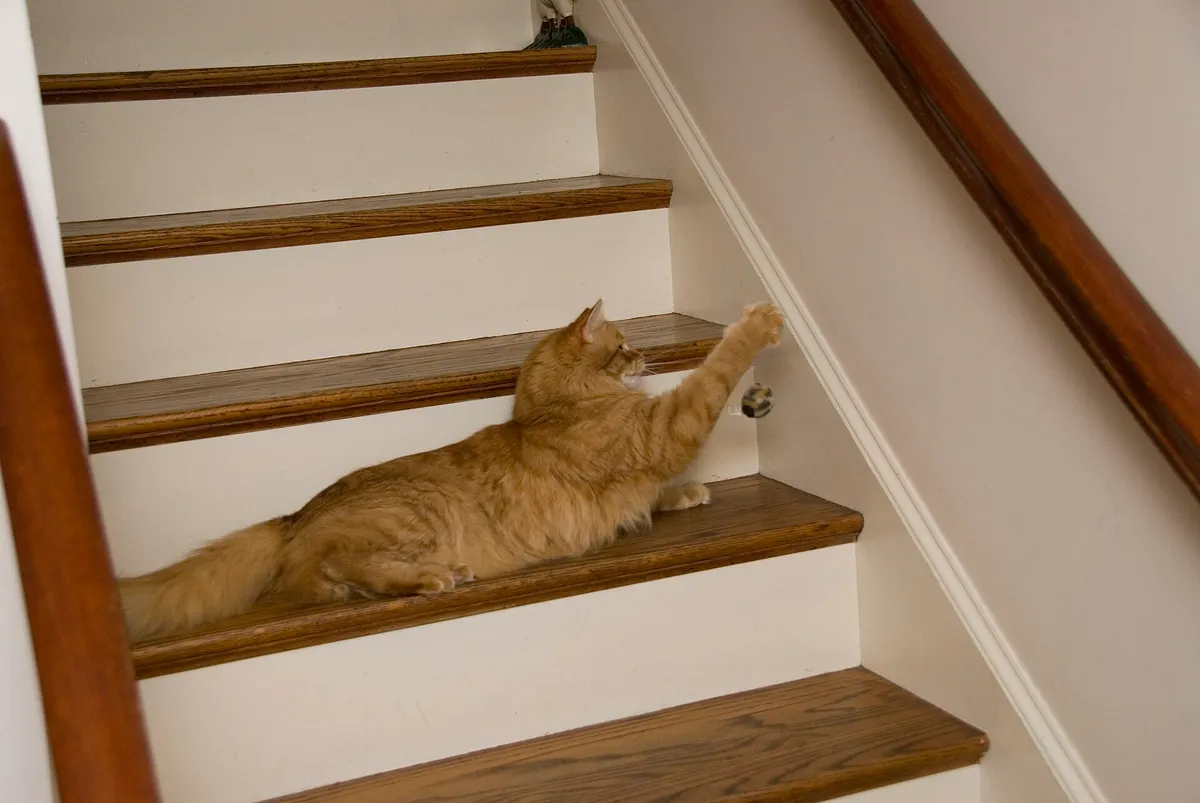
Play is a common time for a tail to puff up, especially in kittens and young cats. During an intense stalk-and-pounce game, a cat can become so focused and excited that the fur rises. This is sometimes called play arousal. It is not anger and it is not fear. The cat is simply flooded with adrenaline.
How can you tell the difference? A playful cat will usually still be moving toward the toy, with forward ears and a relaxed, wiggly body. A fearful cat is more likely to freeze, flatten its ears, and move away. If your cat's tail puffs during play and then goes back to normal when the game ends, that's a normal feature of an active hunt-like game.
What about the happy tail? Some people use the phrase happy tail to describe a tail held high with a relaxed curve, or a tail that flicks gently when a cat is content. A puffed tail is different. It is a high-arousal signal. Even if it appears during play, the cat's body language will show that the cat is not calm. So while you can call it an excited tail, do not mistake it for the relaxed greeting tail.
What to do when your cat's tail puffs up
Your first job is to identify the trigger. If the puff happened after a sudden noise, give the cat space and let it calm down. Do not chase, grab, or restrain a cat whose tail is puffed. The raised fur is a warning that the cat may lash out if it feels trapped. Speak softly and avoid staring directly at the cat.
If the trigger is a threat the cat can see, such as another cat outside, remove the visual or move the cat away. Closing the blinds or carrying the cat to a quieter room can help.
If the tail puffs during play, pause for a moment to let the cat reset. You can toss a toy across the room instead of reaching for the cat. This keeps the game fun and reduces the chance of an accidental bite.
Never punish a cat for a puffed tail. Piloerection is involuntary, and punishment only raises the cat's fear and arousal. If your cat is frequently puffed, stressed, or reactive, an accredited behaviorist or your veterinary clinic can help you find the underlying cause.
Why some cats puff more than others
Individual cats differ a lot in how easily their fur stands up. Some cats are naturally more reactive, with a quicker startle reflex. Kittens often puff more than adult cats because they are still learning what is safe and what is not. Long-haired cats may look more dramatic when their fur puffs, simply because they have more fur.
Breed can play a role too. Some breeds are known for being more vocal or more intense, but any cat of any breed can puff its tail. Previous experience also matters; a cat that has been frightened in the past may be quicker to raise its fur. None of this means the cat is angry or mean. It means the cat's nervous system is paying attention.
Frequently Asked Questions
Why does my cat's tail puff up when it sees another cat?
That is usually defensive arousal. The cat is alerting the other cat to stop approaching, or making itself look bigger. It may be accompanied by hissing or a low growl. If your cat is an indoor cat and sees an outdoor cat through a window, blocking the view can reduce the stress.
Can a happy cat's tail puff up?
A truly content cat is usually relaxed, with soft eyes and a gently curved tail. A puffed tail is a sign of high arousal, not contentment. However, a cat can be happily excited during play and still show a puffed tail. The difference is in the rest of the body.
My kitten's tail puffs up when it's chasing a toy. Is that normal?
Yes. Kittens often get so caught up in a hunt-like game that their fur stands up. As long as the kitten is moving forward, ears forward, and not hissing, it is likely enjoying the game. Give it plenty of playtime and let it catch the toy so the game ends with a win.
Should I touch my cat's tail when it's puffed?
No. A puffed tail means the cat is on alert. Touching it could startle the cat and trigger a defensive reaction. Wait until the fur lies flat and the cat's body relaxes before you reach out.
How long does a puffed tail last?
It usually lasts only a few seconds to a minute, depending on the trigger. If the threat stays, the tail may stay puffed longer. Once the cat feels safe, the fur should settle. If it seems stuck in a high-arousal state, give it more space.
Key Takeaway
A puffed tail is a visible burst of adrenaline. In most cases it means your cat is startled, fearful, or on the defensive. It can appear during excited play, but it is still a sign of arousal, not a relaxed greeting. The fastest way to help is to read the whole body, identify the trigger, and give the cat space to calm down. With patience, you can learn to tell the difference between a scared puff and a playful puff—and respond in a way that keeps your cat feeling safe.
Sources & Scientific References (3)
Share this guide
Help another cat parent find it.