The short answer
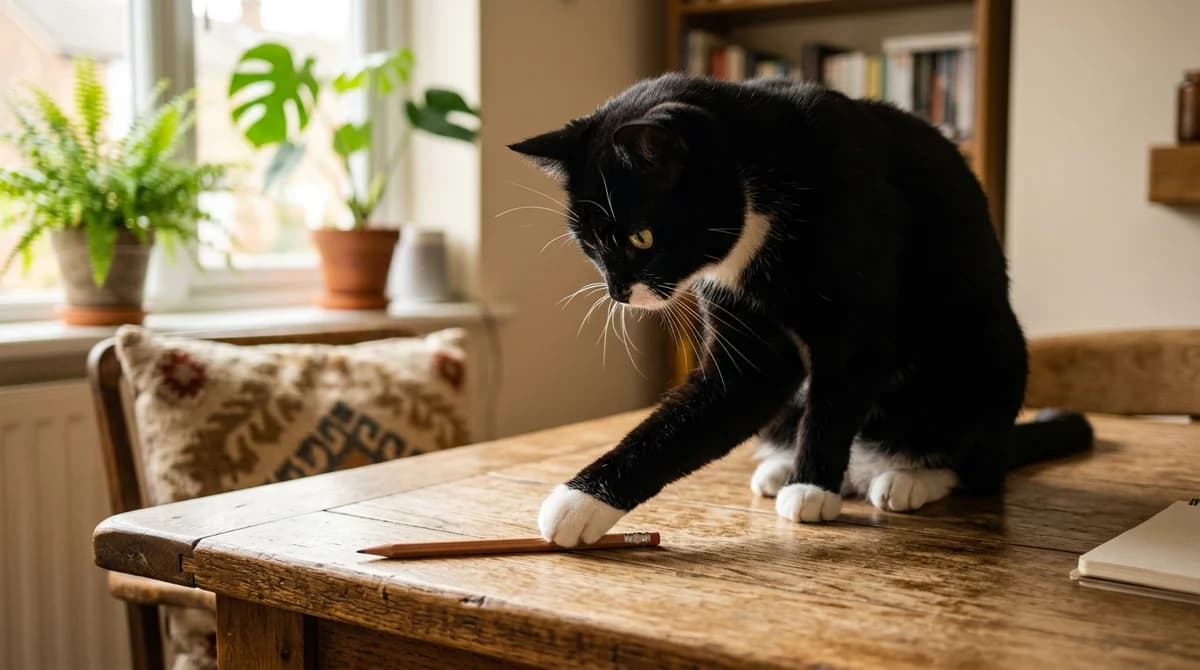
Cats knock things off tables and counters for reasons that make perfect sense to them, even when it looks mischievous to us. Most of the time it comes from three natural drives: the instinct to bat at and test objects with their paws, the appeal of watching something move and fall, and a learned habit that your reaction usually follows. What it is not, behavior experts agree, is spite. Your cat is not plotting against your mug or your vase. That pawing action is the same motion a wild cat uses to test whether prey is alive, and a falling object behaves a lot like prey that has darted away. The movement, the sound, the crash — for a cat, it is a satisfying little game, and the game is its own reward.
Why cats bat at things in the first place
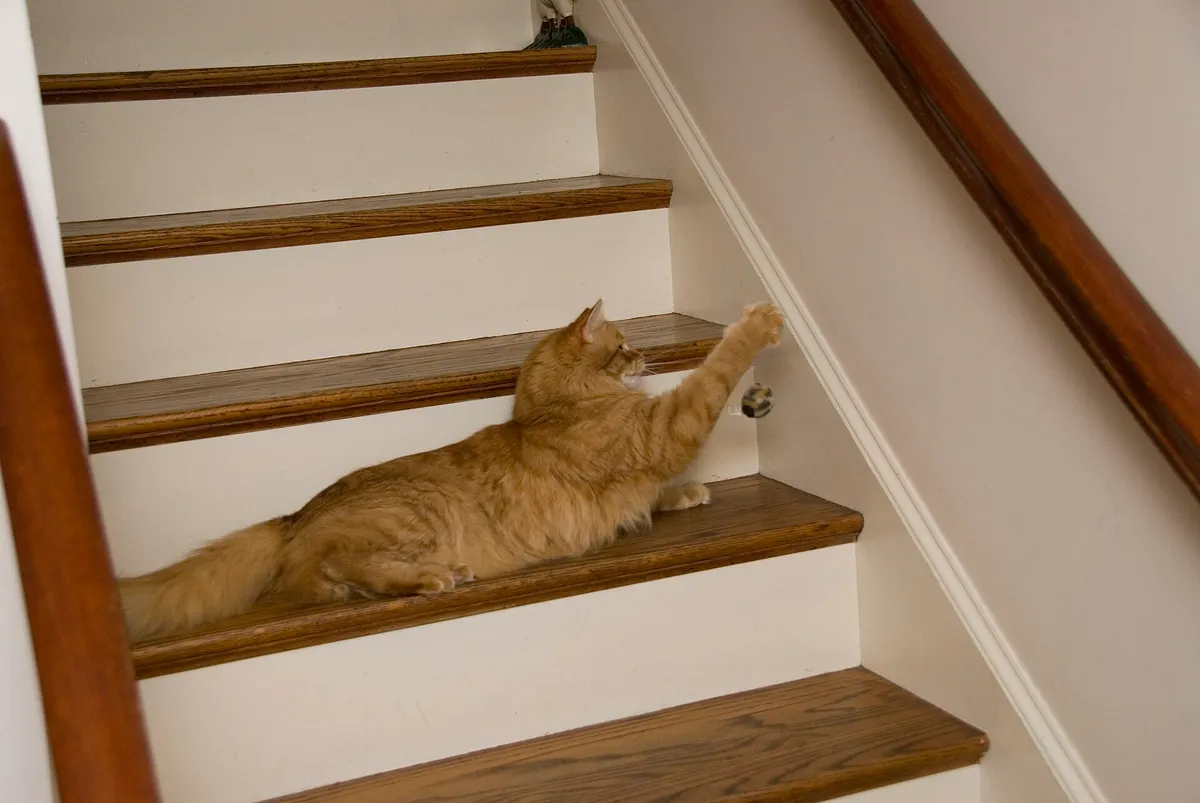
Cats are extraordinary with their front paws — far more dexterous than many people realize. Their forepaws are packed with nerve endings, and they also have small whiskers on the backs of their wrists (carpal whiskers) that help them sense what they touch. When a cat bats an object, it is gathering information: Is this alive? Does it move? Is it safe or interesting? In the wild, cats paw at prey to test whether it is still active before committing to a bite. That same “test the object” behavior carries over to the kitchen counter.
So the knock is not random. The object is not annoying your cat; it is simply there — within paw range, at the right height, with an interesting shape — and the cat’s brain flags it as something worth investigating. To a cat, a phone, a spoon, or a ceramic dish is an invitation to explore with the paw.
The fall is the fun part
Here is where the behavior becomes self-reinforcing. When a cat pushes an object and it falls, several interesting things happen at once: it moves quickly, it makes a sound, and it changes position. To a cat’s brain, that looks a lot like prey that has been batted and is now flailing or trying to escape. Behaviorists call this self-reinforcement: the cat does not need a reward from you to find the experience worthwhile.
Cats are also quick learners. If knocking a mug off the table produces a satisfying crack and a flash of movement, the connection “push equals fun” gets stronger. Over time, this can become a favorite game, especially for active indoor cats. That is why the behavior can feel so persistent — the cat is playing with cause and effect, and every successful knock trains the sequence a little more.
Boredom, play drive, and the indoor hunter
Cats are born predators, and play is how they practice hunting. A complete hunt includes stalking, chasing, pouncing, batting, and a final bite. An indoor cat rarely gets to finish that sequence — there is no live prey in the living room. But every object sitting at the edge of a table looks like a mini prey item: vulnerable, at the boundary, begging to be batted. Boredom makes this stronger. Under-stimulated cats invent their own games, and table-knocking is one of the more creative ones.
That is why the most effective long-term fix is enrichment, not scolding. Cats who get daily interactive play, puzzle feeders, climbing space, and toys that move erratically are far less likely to treat your shelves as a game. The goal is to let the hunting sequence play out against appropriate targets — a wand toy that darts like a mouse, a ball that rolls unpredictably, a food puzzle that rewards paw work.
Is it attention-seeking?
Sometimes, yes — but not in the way humans usually mean the word. Cats are brilliant at noticing patterns. If knocking a spoon off the counter reliably makes you look up, gasp, or chase after the spoon, your cat has learned that the action produces a response. For a bored or lonely cat, even a negative reaction is still interaction. You become part of the game: the object falls, and the human performs.
That does not make the cat spiteful or manipulative in a human sense. There is no evidence that cats act from revenge. What looks like “he stared right at me and pushed it off” is usually a cat that has learned the payoff and is waiting for the expected result. To change the behavior, change the payoff: keep the crash boring, and give your cat plenty of attention when it plays with appropriate toys instead.
Why tables and counters make such good targets
Several factors make elevated surfaces irresistible. First, height is security: cats feel safer and more in control when they can survey the room from above. Second, tables and counters are where humans keep things — and human things carry interesting smells, textures, and shapes. Third, edges are visual triggers. A paw is naturally drawn to something waiting at the edge of a surface; it is the same curiosity that makes cats poke at the world around them. Finally, counters often carry food smells, which adds extra hunting interest.
None of this makes the behavior “bad.” It is a cat being a cat. Your job is to keep the environment safe and give your cat better outlets — not to convince the cat that gravity is serious business.
What to do about it
Start with safety, then work on prevention and redirection.
Consider what is in paw’s reach before anything else. A falling glass can shatter and cut paws; a hot cup can cause a painful burn; candles can be knocked onto carpet; and medications, cleaning products, batteries, or toxic plants on a counter are serious hazards. Keep anything fragile, hot, sharp, or poisonous away from edges — preferably in a closed cabinet. If your cat knocks things down often, secure display items with the kind of putty used for childproofing, or store them behind glass.
Then offer something better to do. Two or three interactive play sessions a day, about ten to fifteen minutes each, let your cat act out the hunting sequence on a toy instead of your coffee mug. Puzzle feeders and treat-dispensing balls turn mealtimes into problem-solving. Novelty helps too: rotate toys so they stay interesting, and add cat shelves, perches, or a window bed so your cat has high places that are truly theirs.
When a knock does happen, keep it boring. If it is safe, clean up without drama. Never yell, spray, or scold — punishment does not teach a cat what to do instead, and it can make your cat anxious or secretive. Redirect instead: bring out a toy, start a play session, and reward the behaviors you want with attention and treats.
Here is a quick reference for common fixes:
| Change | Why it helps | Example |
|---|---|---|
| Clear the edge | Removes the tempting target | Move glasses, remotes, and keys back or into a tray |
| Secure valuables | Removes the reward and the risk | Display putty, closed cabinets, heavier bases |
| Add play sessions | Satisfies the hunting drive safely | Two 15-minute wand-toy sessions a day |
| Use puzzle feeders | Gives the paws a job to do | Treat ball, snuffle mat, food puzzle |
| Provide cat-height spots | Gives your cat a place of their own | Cat tree, wall shelf, window perch |
| Ignore the knock (when safe) | Removes the attention payoff | Clean up calmly, then play with a toy |
Frequently Asked Questions
Is my cat knocking things off the table to upset me?
No. Cats do not hold grudges or act out of spite. The behavior comes from natural pawing instincts, the appeal of movement, and learned patterns — not from a desire to annoy you. Even when your cat looks at you right before pushing something off, it is usually anticipating the payoff, not plotting revenge.
Why does my cat stare at me while knocking things off?
Because, from your cat’s point of view, you are part of the game. If you consistently respond — gasping, running over, or picking the object up — the cat learns the sequence includes you. To break the loop, keep your reactions boring and give attention when your cat chooses toys over gravity.
Will buying more toys stop the behavior?
Toys help a lot, but they are not magic. They only work if they stay interesting, which means rotating them, playing with your cat, and choosing toys that mimic prey — things that dart, skitter, and squeak. Combine good toys with scheduled play, and the behavior usually fades.
Should I punish my cat for knocking things over?
No. Punishment — yelling, spraying, or tapping — does not teach an alternative and can damage your bond. It can also increase anxiety, which tends to create more problem behaviors, not fewer. Prevention, redirection, and positive reinforcement work far better.
When should I worry about the behavior?
Table-knocking is completely normal. But if the behavior suddenly becomes obsessive, or appears together with other changes in your cat’s usual personality, energy, or routine, a check-up with your vet is a reasonable next step. Sudden behavior changes can sometimes point to a physical issue, and your vet is the right person to rule that out.
Key Takeaway
Knocking things off tables is completely normal cat behavior, rooted in predatory instincts, a love of cause and effect, and a need for engagement — not in spite or revenge. Respond with practical steps: keep risky items out of paw’s reach, make play an everyday priority, and stay calm when the occasional crash still happens. With a little environmental tweaking and plenty of satisfying play, your cat’s inner hunter can enjoy the game without turning every tabletop into a launchpad.
Sources & Scientific References (3)
Feline Behavior and Environmental Enrichment
Cornell Feline Health Center • Accessed 2025-07-01
Advice for Owners: Understanding Cat Behavior
International Cat Care • Accessed 2025-07-01
Feline Behavior Resources for Cat Owners
American Association of Feline Practitioners • Accessed 2025-07-01
Share this guide
Help another cat parent find it.