The short answer
If your cat scrapes the floor next to the bowl, sniffs around, and then makes little digging motions with their paws, what you are seeing is a behavior rooted in survival. Cats do not cover their food because they are feeling spiteful or because they dislike dinner. They do it because their wild ancestors evolved to bury leftover food to keep the scent from attracting predators and rival cats. The motion is instinctive, and many indoor cats keep doing it even when the food bowl never needs hiding.
What does food-covering look like?
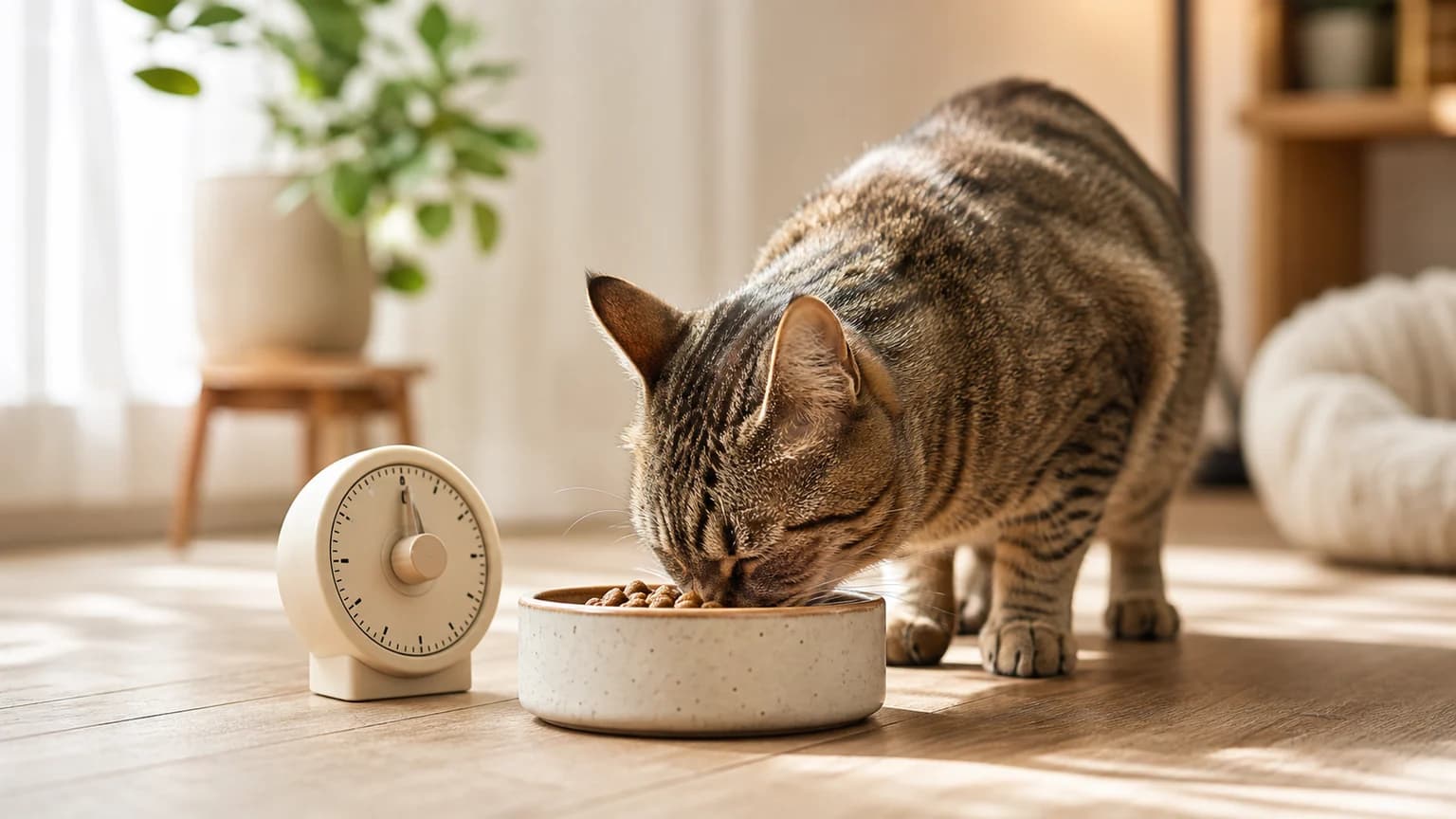
Some cats are very obvious. They hook the food bowl with a paw, drag a nearby towel over it, and even nose around for more material. Others barely tap the floor beside the bowl and then look at you as if they expect a second course. A few cats perform the whole ritual in the air a few centimeters from the bowl, scratching at invisible dirt. This is sometimes called food-burying or caching behavior. It can happen right after a meal, halfway through eating, or before the first bite. Many cats also sniff the area, circle, and maybe flatten their ears slightly.
Why do wild cats bury food?
In the wild, a cat that makes a kill enjoys a rare meal. She may eat part of it and then cover the rest with leaves, dirt, or grass. That hiding strategy is called caching. Caching does several jobs at once. It keeps the carcass away from vultures, other predators, and scavenging insects. It drops the smell level so a larger predator cannot track the scent to a defenseless cat. It also stores the food for a later meal. A mother cat may bring prey back to her kittens, and the kittens learn these habits by watching her. The domestic cat’s pawing ritual may be an echo of that lesson.
Why do indoor cats still do it?
The modern house cat is not thinking, "There is too much food, I must save it for tomorrow." The brain is running older software. Food-covering often shows up with food that has a strong smell, a large portion, or a bowl placed in a busy or exposed spot. It may also appear when a cat is not fully enthusiastic about what is being served. That does not mean the cat hates the food. It simply means that something about the situation lines up with the instinct. Personality matters too: some cats are quick to paw and scrape, while others never do it. Cats that spent time outdoors, or that previously had to compete for meals, may be more likely to show the behavior.
Is it a form of scent marking?
There's more going on than hiding. Cats have scent glands in their paws, cheeks, chin, and forehead. When they scratch at the floor, they leave behind their own chemical signature. This can be a way of saying, "This is my food territory." The scratching, kneading, and tapping around the bowl can release pheromones from the skin between the toes. So the behavior may be a combination of caching and scent-marking rather than one single motive.
Why some cats cover food more than others
Genetics is a big part. Some cats are descendants of hunting-focused mothers, while others come from lines bred mainly for looks and temperament. A cat with a high prey drive is more likely to show caching behavior. Early life matters too. Kittens who grew up in a litter may be used to competition; they might eat quickly and then try to hide what is left. A cat that was once a stray may have learned to cover food to avoid being found by other street cats. Even pure indoor cats from confident homes can do it daily because the action feels rewarding. The important point is that each cat is an individual. Neither a cat who covers food nor a cat who never does is "wrong."
Should you be worried?
Food-covering by itself is a normal, mostly harmless quirk. The only real problems are practical ones. Paws scraping against a tile floor can be noisy. A determined cat can knock over a bowl, spill water, and push dry food under the fridge. Occasionally, a cat will try to bury the bowl so hard that it flips. If your cat uses clothing, towels, or toys to pile on the bowl, keep an eye out for fabric or string that could be chewed and swallowed. Let the cat perform the ritual, but choose a spot that is easy to clean.
If your cat suddenly starts covering food when they never did before, and the routine change comes with weight loss, leaving food untouched, vomiting, or low energy, treat it as a prompt to book a veterinary visit. Food-covering alone is normal, but a sudden shift in eating habits can be an early clue that something else is going on. Also check that any cloth or toy used for "burying" is not made of something that could be chewed into pieces.
How to support your cat's instinct without supervising every meal
Set up a digging-friendly station. A non-slip rubber mat or an old towel placed under the bowl gives the cat a surface that can take light scratching. Use an open bowl rather than a deep one so the cat can see the food and move around it. If the cat loves to cover leftovers, offer a small portion at mealtime and see if the scraping stops once the bowl is empty. Many cats only feel the urge when there is extra to protect. For cats that need more mental work, a food-dispensing puzzle replaces the burying ritual with a hunting one. Snuffle mats, rolled towels with kibble inside, and puzzle feeders let the cat use paws and nose in a way that feels satisfying.
What not to do
Never punish a cat for covering food. Punishment is confusing because the scratching is a natural behavior, not a misbehaving choice. It can damage the bond and make the cat more stressed, which may increase the very behavior you want to reduce. Instead, change the environment. If the cat scratches a wall near the bowl, move the bowl away from the wall or put a small scratching pad beside it. Directing the behavior toward safe surfaces is easier than stopping it.
Here's a quick guide to what you might see and how to respond.
| What you see | What is likely going on | How to respond |
|---|---|---|
| Pawing at floor beside bowl | Instinct to cover uneaten food | Provide a mat or towel; keep portions moderate |
| Dragging toys or cloth over bowl | Caching behavior learned from ancestral habits | Let it happen if materials are safe to swallow |
| Scratching at wall or counter near food | Scent-marking plus the urge to dig | Move bowl to open space; add vertical scratcher nearby |
| Covering food and walking away | Smaller appetite or a portion too large | Offer smaller meals, check feeding total with your vet if concerned |
Frequently Asked Questions
Why does my cat only bury wet food and not dry food?
Wet food has a stronger smell than kibble. The strength of the odor may be the trigger that tells the brain "this is food worth hiding." That's not a sign you should stop feeding it, but you might notice the behavior mostly after canned or pouch meals.
Does food-covering mean my cat doesn't like the food?
Not necessarily. Many cats perform the same digging routine with food they eat eagerly. It can be triggered by the presence of leftover food, the size of the bowl, the location, or simply the cat’s personality. If your cat eats the food and then goes through the motions, that's not an expression of disgust.
Should I stop my cat from covering food?
Only if the cat is about to tip over a bowl, spill water onto an electrical item, or swallow unsafe material. Otherwise, allow it. It is a natural behavior. You can quietly place a mat or towel under the setup and let the ritual play out.
Can food-covering be a sign of stress?
Sometimes. A cat that feels insecure about its resources may hide food more often, especially in multi-cat homes. If the behavior appears along with other changes like hiding, lip-licking, or avoiding certain rooms, it is worth looking at the cat's overall environment and providing more safe, elevated places. Sudden changes in appetite or weight deserve a veterinary check.
Key Takeaway
Food-covering is an inherited hunting and survival strategy, not a judgment about your cooking or a revenge plot. It is normal, harmless, and interesting. Let your cat carry out the ritual on a safe surface, offer meals in appropriate portions, and use puzzle feeders if you want to channel the energy. You will understand your cat better and probably enjoy the little show at dinnertime.
Share this guide
Help another cat parent find it.