The short answer
The short answer is that your Christmas tree, tinsel, ornaments, ribbon, and a house full of guests can all create real risks for your cat. With a few simple precautions, you can keep the holidays fun and avoid an emergency vet visit. The biggest dangers are intestinal blockages from string-like decorations, burns or shocks from power cords, and stress from a disrupted household routine. Cats are naturally curious, so the goal is not to make the tree off-limits. Instead, make the tree uninteresting and the area around it safer.
Why Christmas trees are irresistible to cats
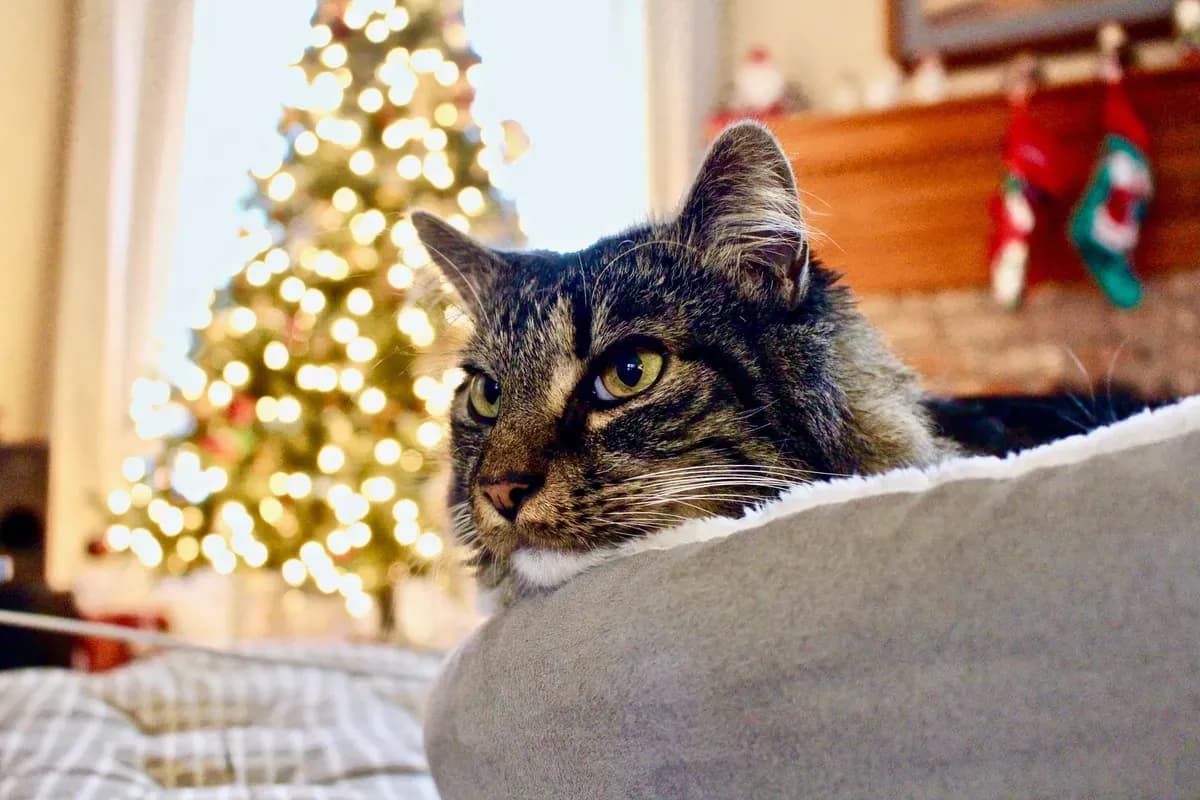
Indoor cats rarely get to climb real trees, and a tall, fragrant structure appearing in the living room is an invitation. Pine needles can cause issues if chewed: they may irritate the mouth and stomach, and sharp pieces can cause a small puncture. Tree water often contains preservatives and bacteria, and drinking it can make a cat vomit. Cover the water stand with a sturdy tree skirt. To prevent toppling, anchor the tree to the wall or ceiling with a strong wire. Keep the tree away from shelves and tables a cat could launch from. If your cat is very active, consider a tabletop tree in a room you can close, or delay decorating until a few days before Christmas.
Tinsel, ribbon, and ornaments: hidden dangers
Cats love anything that catches light and dangles, making tinsel and ribbon irresistible. Because they are string-like, they are among the most dangerous decorations a cat can swallow. A long, thin object can become a linear foreign body: one end catches in the stomach while the rest moves through the intestines, causing severe damage that may require surgery. Never pull tinsel or ribbon out of a cat's mouth or bottom if you see it; that can tear the gut. Cut the visible end, keep the cat calm, and call your veterinarian immediately.
String-like objects are one of the most urgent holiday emergencies. Never pull a length of tinsel, ribbon, or thread out of a cat's mouth or rear. This can cause severe internal tearing. Instead, cut the visible end, keep the cat calm, and call your vet immediately.
Glass ornaments can shatter and cut paws. Small wooden, salt-dough, or paper ornaments can be swallowed. Metal hooks commonly injure mouths and throats. Use shatterproof plastic or fabric ornaments, secure them with short twine instead of hooks, leave the lower branches bare, and keep all tinsel and ribbon in a sealed drawer.
Lights, cords, and electrical hazards
Chewing on light cords can burn a cat's mouth or deliver a painful shock. In serious cases, swelling from a tongue burn can affect breathing. The easiest way to prevent this is to make cords unreachable. Wrap cords in flexible tubing or spiral covers, hide the power strip behind furniture, and unplug the lights when you are not home or overnight. Check cords for bite marks and replace any that are frayed. Use a power strip with a built-in circuit breaker. Battery-operated LED candles give the same glow without an open flame, and they are far safer in a cat household because a curious paw can easily knock over a real candle.
Plants and food: the holiday dining hazards
Mistletoe, holly, and lilies are often brought inside at Christmas, and several are unsafe for cats. Lilies are especially dangerous; even a small nibble on a leaf or a lick of pollen can cause kidney failure. Poinsettias are far less dangerous than their reputation, but the white sap can irritate the mouth and cause drooling or vomiting. The safest rule is to keep all plants out of reach and never allow lilies into a cat household. If a bouquet contains lilies, remove them before bringing it home.
Holiday meals also mean leftover chocolate, rich meats, and sweet treats. Chocolate contains compounds that are unsafe for cats, and fatty foods can trigger an upset stomach or a painful pancreas condition called pancreatitis. Raisins and grapes can damage a cat's kidneys, and onions and garlic, often hidden in stuffing, can lead to anemia. Small bites of plain, unseasoned turkey are usually okay, but the safest approach is to treat all human holiday food as off-limits and keep the trash can secured.
Guests and holiday chaos: stress and escape risks
Guests are wonderful, but for many cats, a house full of strangers is stressful. Some cats hide, while others overgroom, eat less, or stop using the litter box. A quiet escape room is the best solution. Set up a bedroom or bathroom with food, water, a litter box, a bed, and a few toys, and let your cat choose when to retreat there. Ask guests not to chase or pick up a frightened cat, and tell children to leave the cat alone in its safe space. Doors opening and closing can also lead to an escape. Keep your cat in a closed room during large gatherings, post a sign to close the door, and check guests' bags and coats before they leave—a cat has been known to nap in an open suitcase.
When to call the veterinarian right away
Call your veterinarian immediately if your cat has swallowed tinsel, ribbon, or any string-like object, or if you see drooling, gagging, repeated vomiting, a painful abdomen, or a lack of appetite. These can be signs of an intestinal blockage. A sudden collapse, difficulty breathing, or a visible burn in the mouth also need urgent care. Keep your vet's phone number and an after-hours emergency clinic number on the fridge. Some signs, like a single hairball, are normal, but a string-like object changes the situation dramatically. It is always better to call than to wait and hope.
A holiday hazard checklist
Use this checklist before the celebrations begin to spot common hazards.
| Risk | What to do |
|---|---|
| Tree toppling | Anchor the tree to the wall or ceiling with a strong wire or bracket |
| Tinsel, yarn, ribbon | Keep these string-like items out of the house or in a sealed drawer |
| Ornament hooks | Use short twine or paper clips; skip metal hooks |
| Glass ornaments | Use shatterproof plastic, fabric, or felt ornaments |
| Light cords | Cover cords in tubing; unplug overnight and when away |
| Tree water | Cover the base with a tree skirt; don't let cats drink it |
| Lilies | Remove from bouquets; never bring lilies into a cat household |
| Chocolate, raisins | Store sweets in sealed containers and keep trash in a lidded bin |
| Candles and flames | Use battery-operated LED candles instead |
| Stressful visits | Create a quiet safe room with food, water, litter, and toys |
| Door escapes | Post a sign and keep the cat in a closed room during gatherings |
Frequently Asked Questions
Is an artificial tree safer than a real tree?
Artificial trees don't drop water or pine needles, but they still have plastic leaves and electrical cords that can be chewed. Both options are workable if the tree is anchored and the lower branches are unadorned. The bigger risk is usually the tinsel and ornaments, not the tree itself.
What should I do if I see my cat chewing on tinsel or ribbon?
Take the item away immediately and watch for signs like drooling, vomiting, a reduced appetite, or a change in litter box behavior. Because string-like items can twist inside the intestines, call your vet right away if you know or suspect your cat swallowed anything like that.
Are poinsettias dangerous to cats?
Poinsettias are much less dangerous than old rumors suggest. They can cause drooling, mouth irritation, and mild vomiting, but a vet visit is usually not required unless the cat is vomiting repeatedly or showing other signs. Still, it is safer to keep them out of reach.
Can I keep a Christmas tree and still keep my cat safe?
Yes. The key is supervision and simple prevention: anchor the tree, use shatterproof ornaments, skip the tinsel, cover cords, and give your cat a safe room if it gets overwhelmed. Many cat owners enjoy a tree every year without any incidents.
Key Takeaway
The holidays don't have to be a minefield for your cat. The night before you decorate, spend ten minutes checking your plan against the checklist above: anchor the tree, put away string-like decorations, cover cords, and set up a quiet room for your cat. When you do this, you remove most of the serious risks and give your cat a calm escape. The best gift you can give your cat this season is a house where a curious jump doesn't end in a panicked trip to the emergency vet.
Share this guide
Help another cat parent find it.